Talk to The Battle for God like its author wrote you back.
Get the ideas that fit your life — not generic summaries.
- Chat with the book
- Audiobook-style main ideas
- Adapts to your life and goals
- Helps you take action
The Battle for God, in detail
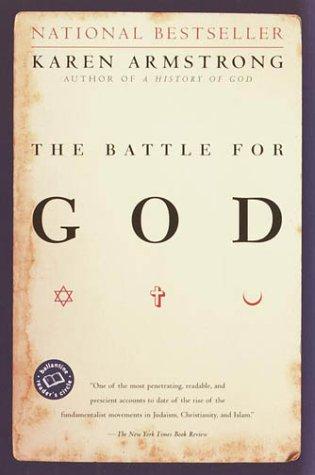
The Battle for God is Karen Armstrong's history of religious fundamentalism across Judaism, Christianity, and Islam from the early modern period to the late twentieth century. Her central argument is that fundamentalism is not a revival of ancient religion but a distinctly modern phenomenon — a reaction to the specific dislocations of modernity rather than a continuity with pre-modern practice. Understanding it requires understanding the conditions that produced it.
Armstrong structures the book around her logos/mythos distinction. Premodern societies operated in both registers simultaneously: logos governed practical knowledge, agriculture, commerce, and warfare; mythos governed meaning, ritual, and ultimate questions. Modernity collapsed this dual structure, elevating logos — empirical, rational, scientific thinking — and marginalizing mythos. Religious communities that tried to convert myth to logos to survive in the new environment distorted both. Fundamentalist movements in all three traditions responded to this distortion, but in ways that made the problem worse: they doubled down on literalism and factual claims, fighting modernity on modernity's own terms.
Armstrong traces three parallel histories. In Judaism, she follows the emergence of ultraorthodox and Zionist movements from eastern European shtetl culture through the Holocaust to the occupied territories. In Christianity, she covers Protestant fundamentalism in America from the Scopes trial through the moral majority. In Islam, she follows the Wahhabi movement in Saudi Arabia and the development of political Islam in Egypt, Iran, and South Asia. Each is a response to a particular historical crisis — colonialism, pogroms, modernization — rather than a timeless religious impulse.
A recurring theme is that fundamentalist movements are driven by fear: fear of annihilation, of irrelevance, of losing identity in a homogenizing modern world. Armstrong's sympathy for the people in these movements, even when she finds their politics catastrophic, distinguishes the book from polemical treatments of the same subject. She argues that dismissing fundamentalism as irrational backwardness misses both its genuine spiritual dimensions and the political conditions that created it.
The big ideas
- 1.
Fundamentalism in Judaism, Christianity, and Islam is a modern phenomenon, not a revival of ancient practice. It emerged specifically in reaction to the disruptions of modernity.
- 2.
Modernity elevated logos — rational, empirical thinking — and displaced mythos — symbolic, meaning-making religion. Fundamentalism is partly an attempt to fight back in logos terms.
- 3.
Each major fundamentalist movement arose in response to a specific historical crisis: ultraorthodox Judaism to pogroms and the Holocaust, American evangelicalism to industrial capitalism and urbanization, Islamism to colonialism and Western-backed authoritarian modernization.
