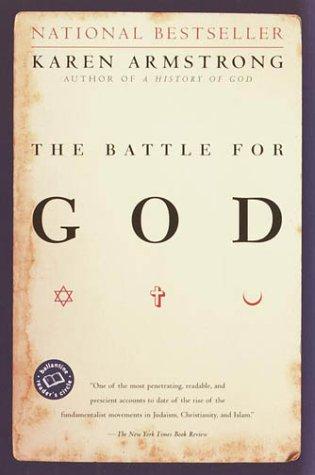
The Battle for God by Karen Armstrong is a 2000 religion & spirituality book about fundamentalism, modernity, religion. Fundamentalism in Judaism, Christianity, and Islam is a modern phenomenon, not a revival of ancient practice. It emerged specifically in reaction to the disruptions of modernity.
Summary
The Battle for God is Karen Armstrong's history of religious fundamentalism across Judaism, Christianity, and Islam from the early modern period to the late twentieth century. Her central argument is that fundamentalism is not a revival of ancient religion but a distinctly modern phenomenon — a reaction to the specific dislocations of modernity rather than a continuity with pre-modern practice. Understanding it requires understanding the conditions that produced it.
Armstrong structures the book around her logos/mythos distinction. Premodern societies operated in both registers simultaneously: logos governed practical knowledge, agriculture, commerce, and warfare; mythos governed meaning, ritual, and ultimate questions. Modernity collapsed this dual structure, elevating logos — empirical, rational, scientific thinking — and marginalizing mythos. Religious communities that tried to convert myth to logos to survive in the new environment distorted both. Fundamentalist movements in all three traditions responded to this distortion, but in ways that made the problem worse: they doubled down on literalism and factual claims, fighting modernity on modernity's own terms.
Armstrong traces three parallel histories. In Judaism, she follows the emergence of ultraorthodox and Zionist movements from eastern European shtetl culture through the Holocaust to the occupied territories. In Christianity, she covers Protestant fundamentalism in America from the Scopes trial through the moral majority. In Islam, she follows the Wahhabi movement in Saudi Arabia and the development of political Islam in Egypt, Iran, and South Asia. Each is a response to a particular historical crisis — colonialism, pogroms, modernization — rather than a timeless religious impulse.
A recurring theme is that fundamentalist movements are driven by fear: fear of annihilation, of irrelevance, of losing identity in a homogenizing modern world. Armstrong's sympathy for the people in these movements, even when she finds their politics catastrophic, distinguishes the book from polemical treatments of the same subject. She argues that dismissing fundamentalism as irrational backwardness misses both its genuine spiritual dimensions and the political conditions that created it.
Talk to The Battle for God like its author wrote you back.
Get the ideas that fit your life — not generic summaries.
- Chat with the book
- Audiobook-style main ideas
- Adapts to your life and goals
- Helps you take action
Key takeaways
- 1.
Fundamentalism in Judaism, Christianity, and Islam is a modern phenomenon, not a revival of ancient practice. It emerged specifically in reaction to the disruptions of modernity.
- 2.
Modernity elevated logos — rational, empirical thinking — and displaced mythos — symbolic, meaning-making religion. Fundamentalism is partly an attempt to fight back in logos terms.
- 3.
Each major fundamentalist movement arose in response to a specific historical crisis: ultraorthodox Judaism to pogroms and the Holocaust, American evangelicalism to industrial capitalism and urbanization, Islamism to colonialism and Western-backed authoritarian modernization.
- 4.
Fundamentalist movements share a defensive posture: they fight to protect a community's identity from a perceived existential threat, often with great discipline and internal solidarity.
- 5.
The attempt to make religion factually accurate — creation science, Quranic inerrancy, halachic minutiae — was itself a modern move, not a return to traditional practice.
- 6.
Zionism and Islamic nationalism both sought political solutions to the same existential problem of Jewish and Muslim communities feeling threatened by modernity.
- 7.
Fundamentalism tends to elevate figures who were marginal in classical tradition: populist preachers rather than theologians, activist organizers rather than quietist mystics.
- 8.
Dismissing fundamentalism as backward or irrational prevents secular liberals from understanding it — and from addressing the conditions that created it.
Discussion questions
Use these on your own, with a book club, or as chat starters in Superbook. Book club version, ready to copy or print →
- 1.
Armstrong argues fundamentalism is a product of modernity, not a continuity with tradition. Does this frame change how you think about fundamentalist movements you've observed?
- 2.
The logos/mythos distinction is central to the book. Do you think most religious practitioners today operate primarily in logos mode, mythos mode, or some mix of both?
- 3.
Armstrong identifies fear as the core emotion driving fundamentalism. Does that diagnosis seem accurate to you, and does it change your ethical response to these movements?
- 4.
What distinguishes a legitimate religious traditionalism from the kind of defensive fundamentalism Armstrong describes? Is there a clear line?
- 5.
Armstrong treats Jewish ultraorthodoxy, American evangelical fundamentalism, and political Islam as versions of the same phenomenon. Does that comparison illuminate or flatten important differences?
- 6.
She argues that secular liberals misunderstand fundamentalism by treating it as purely irrational. What would it mean to take fundamentalism seriously without endorsing it?
- 7.
How do you think secularization theory — the idea that modernization causes religion to decline — holds up after reading this book?
- 8.
Many fundamentalist movements also provide social services, community, and meaning that the secular state doesn't. How does that function factor into your assessment?
- 9.
Armstrong gives significant weight to colonialism in the development of Islamic fundamentalism. Do you think Western policy bears any responsibility for the movements it helped produce?
- 10.
The book ends shortly before September 2001. Looking back from the present, do Armstrong's diagnoses seem to have predicted what followed?
- 11.
Do you see any contemporary secular movements that exhibit the same defensive, identity-protecting structure Armstrong identifies in religious fundamentalism?
- 12.
What would conditions look like in which fundamentalist movements lost their appeal? What would have to change?
Themes
Frequently asked questions
-
What is The Battle for God about?
It is a history of religious fundamentalism in Judaism, Christianity, and Islam from the early modern period to the late twentieth century, arguing that fundamentalism is a reaction to modernity rather than a revival of ancient religion.
-
Is Armstrong sympathetic to fundamentalism?
She is sympathetic to the people in fundamentalist movements and to the genuine spiritual needs that drive them. She is critical of fundamentalism's political effects and its theological distortions, but she resists the dismissive treatment common in secular commentary.
-
How long does The Battle for God take to read?
Roughly eight to nine hours at average reading pace. The book moves between three parallel histories simultaneously, which requires concentration, but Armstrong's prose is clear and accessible.
-
Do I need to read A History of God first?
No, but A History of God provides useful background on the theological traditions Armstrong draws on here. The books are complementary but each stands on its own.
-
Is this book still relevant given events since 2000?
Significantly so. Armstrong's diagnoses of the conditions that produce fundamentalism have been widely cited in discussions of political Islam, Christian nationalism, and Jewish extremism since September 2001.
Similar books
A History of God
Karen Armstrong
The Case for God
Karen Armstrong
The End of Faith: Religion, Terror, and the Future of Reason
Sam Harris

God Is Not Great: How Religion Poisons Everything
Christopher Hitchens
