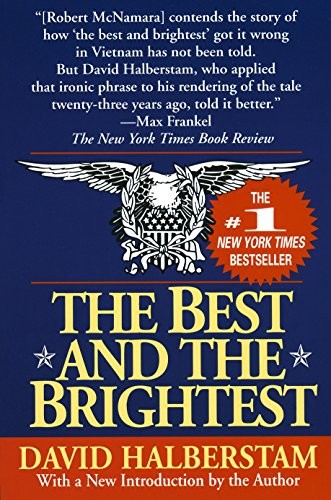
Talk to The Best and the Brightest like its author wrote you back.
Get the ideas that fit your life — not generic summaries.
- Chat with the book
- Audiobook-style main ideas
- Adapts to your life and goals
- Helps you take action
What it argues
David Halberstam's The Best and the Brightest, published in 1972, is both a history of American intervention in Vietnam and a study of institutional failure. The title is ironic: the men who prosecuted the Vietnam War — McNamara, Bundy, Rusk, the Rostows — were the most credentialed, most confident, and by any conventional measure most talented collection of advisors ever assembled in an American administration. Halberstam's argument is that their intelligence, confidence, and mutual reinforcement made them not more likely to succeed but more dangerous.
The book's method is biographical. Halberstam profiles each major figure at length, tracing their career paths, their intellectual formation, their institutional incentives, and the specific decisions they made. The portrait of Robert McNamara is the most extended and the most damning: a systems analyst who believed that Vietnam could be managed through quantifiable metrics, and who continued to apply quantitative frameworks to a situation that was fundamentally political and cultural. McNamara's data said the war was going well long after journalists in the field reported otherwise.
What it gets right
- 1.
The Kennedy and Johnson foreign policy teams were extraordinarily talented by conventional measures. Their mutual confidence and intellectual homogeneity made them less likely to hear contrary information, not more.
- 2.
McNamara's systems-analysis approach to Vietnam produced metrics that could be optimized independently of whether the war was actually being won. The body count became the key indicator because it could be counted, not because it measured what mattered.
- 3.
The bureaucratic logic of escalation operated independently of any individual's judgment: each decision to escalate made the previous investment harder to abandon, and each escalation created new pressures for the next.
What it covers
Who wrote it
David Halberstam (1934–2007) was an American journalist and author. He reported for The New York Times from Vietnam in the early 1960s, where his dispatches challenged official optimism and contributed to public skepticism about the war. He won the Pulitzer Prize for International Reporting in 1964. His books include The Making of a Quagmire, The Powers That Be, The Reckoning, Summer of '49, and Playing for Keeps. He covered wars, politics, business, and sports across a career spanning five decades. He died in a car accident in 2007.
