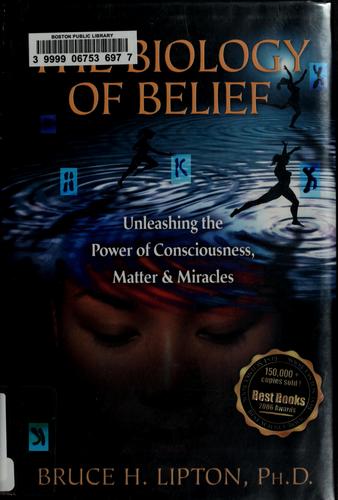
Talk to The Biology of Belief like its author wrote you back.
Get the ideas that fit your life — not generic summaries.
- Chat with the book
- Audiobook-style main ideas
- Adapts to your life and goals
- Helps you take action
The Biology of Belief, in detail
The Biology of Belief is Bruce Lipton's argument that cells are controlled by signals from their environment rather than by genetic programs, and that human beings, as collections of cells, are therefore more powerfully shaped by their beliefs and perceptions than by their DNA. Lipton, a former medical school professor and cell biologist, builds his case from cellular biology: specifically from his research on the membrane proteins that regulate what enters and exits a cell. He argues that the standard model of gene-as-blueprint is a fundamental misreading of how biology actually works.
The book's core scientific argument draws on signal transduction — the process by which cells detect and respond to environmental signals. Lipton argues that the cell membrane, not the nucleus, is the brain of the cell, and that the proteins in the membrane respond to chemical signals from the environment by altering which genes are expressed. Applied to the whole organism, this becomes the claim that the chemical environment of your cells — which is substantially shaped by your emotional and psychological state through the stress response and neuroendocrine signaling — determines your biological functioning in ways that dwarf genetic predisposition.
Lipton extends this to what he calls the primacy of the subconscious mind: most of our automatic responses, he argues, are programmed in early childhood before we have conscious agency, and running these programs creates the chemical environment our cells inhabit. Changing your biology, on this account, requires reprogramming subconscious beliefs, not just consciously choosing better behaviors. He devotes the book's later sections to this claim, drawing on neuroscience of early development and approaches like hypnotherapy and energy psychology.
The book has been widely criticized within the scientific community for overstating its claims and misrepresenting mainstream biology. Lipton is a legitimate cell biologist, but the leap from cellular signal transduction to the primacy of belief as a biological force involves several steps the evidence does not cleanly support. Readers who approach it as an interesting extension of genuine ideas in epigenetics and psychoneuroimmunology will get something from it; those who treat it as settled science will be on shakier ground than the confident tone suggests.
The big ideas
- 1.
Cells respond primarily to environmental signals through membrane proteins, not to genetic instructions from the nucleus; the membrane, not the DNA, is the functional brain of the cell.
- 2.
Gene expression is substantially regulated by the chemical environment surrounding cells, which includes hormones and neuropeptides released in response to psychological states.
- 3.
Beliefs and perceptions shape biology by creating the chemical environment — stress hormones, inflammatory signals — that cells actually inhabit moment to moment.
