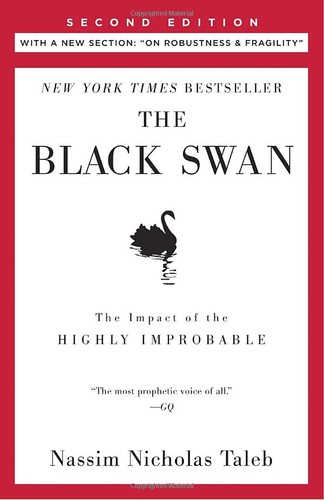
Talk to The Black Swan: The Impact of the Highly Improbable like its author wrote you back.
Get the ideas that fit your life — not generic summaries.
- Chat with the book
- Audiobook-style main ideas
- Adapts to your life and goals
- Helps you take action
The Black Swan: The Impact of the Highly Improbable, in detail
The Black Swan is Nassim Nicholas Taleb's argument that the most consequential events in history — financial crashes, technological breakthroughs, wars, pandemics — are not predictable outliers but structurally unpredictable ones. He calls them Black Swans: rare events with massive impact that, once they happen, get explained away as if they were obvious in hindsight. The name comes from the European assumption, held with complete confidence until Dutch explorers reached Australia, that all swans were white. The discovery of a single black swan demolished the generalization.
Taleb's central claim is that we systematically underestimate our ignorance. He draws a distinction between two statistical domains: Mediocristan, where averages and bell curves work because individual observations are bounded (human height, for example), and Extremistan, where a single event can dominate the entire distribution (book sales, wealth, casualties in war). Most of the phenomena that actually shape history live in Extremistan. Yet economists, strategists, and risk managers keep applying Mediocristan tools to Extremistan problems, producing models that are confident but fragile.
The book is also a meditation on narrative. After a Black Swan occurs, humans construct a story that makes it feel inevitable — what Taleb calls the narrative fallacy. This is compounded by the problem of silent evidence: we learn from the survivors and the visible successes, never from the ships that sank without leaving a record. Combine narrative fallacy with silent evidence and confirmation bias, and you get experts who believe they understand the past and can forecast the future, when in fact they understand neither. Taleb does not spare himself from this critique; he writes as a practitioner who lost money trusting his own models before concluding that the models were the problem.
Taleb's prescriptions are less prescriptive than his diagnosis. He argues for robustness over optimization: be prepared to benefit from positive Black Swans and protected from negative ones, rather than trying to predict which will come. This means avoiding debt, keeping slack in your systems, placing small bets on extreme outcomes, and being deeply skeptical of any expert who claims to know where things are heading. The book is at its strongest as a critique of overconfident forecasting and at its most idiosyncratic when Taleb settles scores with economists, journalists, and academics he considers fraudulently certain. Readers willing to work with him through the provocation will find a genuinely useful framework for navigating a world that refuses to behave like a spreadsheet.
The big ideas
- 1.
A Black Swan is a rare, high-impact event that was not predictable in advance but gets rationalized as obvious in hindsight. The category matters more than any specific prediction.
- 2.
Mediocristan is ruled by averages; Extremistan is ruled by outliers. Most of what shapes history — wealth, influence, disasters — lives in Extremistan, where normal statistical tools break down.
- 3.
The narrative fallacy: humans compulsively construct causal stories after the fact, which creates the illusion of understanding and makes unpredictable events look inevitable once they have occurred.
