The Black Swan: The Impact of the Highly Improbable by Nassim Nicholas Taleb is a 2007 science book about uncertainty, probability, epistemology. A Black Swan is a rare, high-impact event that was not predictable in advance but gets rationalized as obvious in hindsight. The category matters more than any specific prediction.
Summary
The Black Swan is Nassim Nicholas Taleb's argument that the most consequential events in history — financial crashes, technological breakthroughs, wars, pandemics — are not predictable outliers but structurally unpredictable ones. He calls them Black Swans: rare events with massive impact that, once they happen, get explained away as if they were obvious in hindsight. The name comes from the European assumption, held with complete confidence until Dutch explorers reached Australia, that all swans were white. The discovery of a single black swan demolished the generalization.
Taleb's central claim is that we systematically underestimate our ignorance. He draws a distinction between two statistical domains: Mediocristan, where averages and bell curves work because individual observations are bounded (human height, for example), and Extremistan, where a single event can dominate the entire distribution (book sales, wealth, casualties in war). Most of the phenomena that actually shape history live in Extremistan. Yet economists, strategists, and risk managers keep applying Mediocristan tools to Extremistan problems, producing models that are confident but fragile.
The book is also a meditation on narrative. After a Black Swan occurs, humans construct a story that makes it feel inevitable — what Taleb calls the narrative fallacy. This is compounded by the problem of silent evidence: we learn from the survivors and the visible successes, never from the ships that sank without leaving a record. Combine narrative fallacy with silent evidence and confirmation bias, and you get experts who believe they understand the past and can forecast the future, when in fact they understand neither. Taleb does not spare himself from this critique; he writes as a practitioner who lost money trusting his own models before concluding that the models were the problem.
Taleb's prescriptions are less prescriptive than his diagnosis. He argues for robustness over optimization: be prepared to benefit from positive Black Swans and protected from negative ones, rather than trying to predict which will come. This means avoiding debt, keeping slack in your systems, placing small bets on extreme outcomes, and being deeply skeptical of any expert who claims to know where things are heading. The book is at its strongest as a critique of overconfident forecasting and at its most idiosyncratic when Taleb settles scores with economists, journalists, and academics he considers fraudulently certain. Readers willing to work with him through the provocation will find a genuinely useful framework for navigating a world that refuses to behave like a spreadsheet.
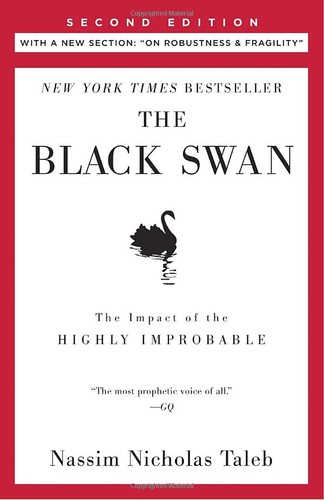
Talk to The Black Swan: The Impact of the Highly Improbable like its author wrote you back.
Get the ideas that fit your life — not generic summaries.
- Chat with the book
- Audiobook-style main ideas
- Adapts to your life and goals
- Helps you take action
Key takeaways
- 1.
A Black Swan is a rare, high-impact event that was not predictable in advance but gets rationalized as obvious in hindsight. The category matters more than any specific prediction.
- 2.
Mediocristan is ruled by averages; Extremistan is ruled by outliers. Most of what shapes history — wealth, influence, disasters — lives in Extremistan, where normal statistical tools break down.
- 3.
The narrative fallacy: humans compulsively construct causal stories after the fact, which creates the illusion of understanding and makes unpredictable events look inevitable once they have occurred.
- 4.
Silent evidence distorts learning. We study successes, survivors, and visible failures. The ships that sank without witnesses never appear in the data, so we systematically overestimate the reliability of whatever strategy seems to have worked.
- 5.
Expert forecasters in complex domains — economics, geopolitics, finance — are rarely better than chance, and often worse because their confidence narrows their thinking. Hedgehogs (one big idea) underperform foxes (many small ideas).
- 6.
The turkey problem: a turkey fed daily for a thousand days has strong statistical reason to believe it is safe. On the thousand-and-first day it learns otherwise. Induction from the past cannot protect against structural breaks.
- 7.
Rather than predicting, build for robustness: avoid catastrophic downside exposure, maintain optionality, and position for positive asymmetry where a rare good event would be transformative while a rare bad one remains survivable.
- 8.
Confirmation bias and the ludic fallacy — mistaking the structured randomness of a casino for the open-ended randomness of real life — are the two cognitive habits that most reliably produce overconfident, fragile decision-making.
Discussion questions
Use these on your own, with a book club, or as chat starters in Superbook. Book club version, ready to copy or print →
- 1.
Taleb argues that the most important events are by definition the ones we failed to anticipate. Does that make planning irrelevant, or does it change what planning should look like?
- 2.
Think of a major change in your own life or career that you did not see coming. Did you construct a clean narrative afterward that made it feel inevitable? What did that narrative leave out?
- 3.
The Mediocristan versus Extremistan distinction is central to the book. Which domain does your industry or profession actually live in, and are you making decisions as if it were the other one?
- 4.
Silent evidence means we mostly learn from survivors. Who or what in your field are you not hearing from, and how might that gap distort your picture of what works?
- 5.
Taleb is sharply critical of academic economists and financial forecasters. Is his skepticism proportionate, or does it slide into a blanket dismissal that has its own blind spots?
- 6.
The turkey problem suggests that long streaks of success can be a warning sign rather than a confirmation. Where in your life are you most vulnerable to this kind of complacency?
- 7.
Taleb recommends holding a barbell portfolio: very safe on one end, very speculative on the other, nothing in the middle. How would that principle apply outside finance — to a career, a creative practice, a relationship?
- 8.
The narrative fallacy makes us feel we understand things we don't. What is a story you tell yourself about your own past that you've never seriously questioned?
- 9.
Taleb distinguishes between positive and negative Black Swans. What would it mean to deliberately expose yourself to more positive ones — and what would you have to give up to do it?
- 10.
The book was published in 2007, before the financial crisis. Does that timing change how you weigh Taleb's arguments? What would a critic say about how he used that event afterward?
- 11.
Taleb's tone is combative and often dismissive of people he disagrees with. Does the style strengthen or weaken the argument for you? Where does provocation help and where does it get in the way?
- 12.
If you accepted Taleb's framework fully, which expert opinions or institutions would you have to stop trusting? Are you willing to pay that cost?
Themes
Frequently asked questions
-
What is The Black Swan about?
It argues that the most consequential events in history are structurally unpredictable — not just hard to forecast but impossible to forecast with standard tools — and that human beings systematically underestimate this and construct false narratives of understanding after the fact.
-
Is The Black Swan worth reading?
Yes, if you work in any domain where tail risks matter: finance, strategy, policy, or any long-horizon planning. The core ideas are genuinely useful and not widely internalized. If you find Taleb's combative style exhausting, the first half of the book makes the case more cleanly than the second.
-
How long does it take to read The Black Swan?
Roughly seven to eight hours at average reading pace for the main text. The book is denser and more digressive than typical business nonfiction, and the second half rewards slower reading. Many readers find the first two-thirds most accessible.
-
Who should read this book?
Anyone making decisions under uncertainty — investors, strategists, executives, policy makers — and anyone who wants a skeptic's framework for evaluating expert forecasts. It's also useful for people who've found themselves surprised by events that 'should have been obvious' afterward.
-
What's the most practical idea in The Black Swan?
The barbell strategy: protect against catastrophic downside while keeping exposure to large upside, and avoid the middle ground of moderate risk for moderate return. Applied to a career, this might mean keeping a stable income source while running low-cost experiments with high potential payoffs.
Similar books
Thinking, Fast and Slow
Daniel Kahneman
Fooled by Randomness
Nassim Nicholas Taleb
Antifragile: Things That Gain from Disorder
Nassim Nicholas Taleb
Thinking in Bets: Making Smarter Decisions When You Don't Have All the Facts
Annie Duke
