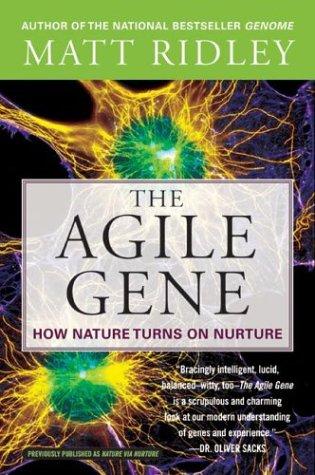
Talk to Nature via Nurture: Genes, Experience, and What Makes Us Human like its author wrote you back.
Get the ideas that fit your life — not generic summaries.
- Chat with the book
- Audiobook-style main ideas
- Adapts to your life and goals
- Helps you take action
What it argues
Matt Ridley's central argument is that the nature versus nurture debate has been framed wrong for over a century. The real story is that genes and environment are not rivals but partners: genes are switched on and off by experience, and experience shapes behavior only through genetic machinery. Ridley proposes replacing the old binary with "nature via nurture" — genes as mechanisms through which environment acts rather than as blueprints that override it.
The book traces how the debate oscillated between biological determinism and blank-slate environmentalism across the twentieth century. Ridley argues that both extremes were politically motivated and empirically mistaken. Twin studies, behavioral genetics, and molecular biology converge on a picture in which roughly half of the variance in most behavioral traits is attributable to genetic differences, roughly half to environmental ones, but the two cannot be cleanly separated because they interact constantly.
What it gets right
- 1.
Nature and nurture are not opposed forces. Genes respond to experience, and experience works through genetic mechanisms. The dichotomy itself is the error.
- 2.
Roughly half the variance in most behavioral traits traces to genetic differences, but those genetic effects are almost always conditional on specific environments.
- 3.
Gene-environment interactions are the norm. A gene for depression raises risk only in people who also experience stress; neither alone predicts much.
What it covers
Who wrote it
Matt Ridley is a British science writer and journalist whose books span genetics, evolution, and economic history. He studied zoology at Oxford and worked as a science editor at The Economist before writing full time. His previous books include The Red Queen, Genome, and The Rational Optimist. Ridley is a fellow of the Royal Society of Literature and has served in the House of Lords as Viscount Ridley. He is known for synthesizing complex science for general readers without sacrificing accuracy.
