Nature via Nurture: Genes, Experience, and What Makes Us Human by Matt Ridley is a 2003 science book about genetics, human nature, evolution. Nature and nurture are not opposed forces. Genes respond to experience, and experience works through genetic mechanisms. The dichotomy itself is the error.
Summary
Matt Ridley's central argument is that the nature versus nurture debate has been framed wrong for over a century. The real story is that genes and environment are not rivals but partners: genes are switched on and off by experience, and experience shapes behavior only through genetic machinery. Ridley proposes replacing the old binary with "nature via nurture" — genes as mechanisms through which environment acts rather than as blueprints that override it.
The book traces how the debate oscillated between biological determinism and blank-slate environmentalism across the twentieth century. Ridley argues that both extremes were politically motivated and empirically mistaken. Twin studies, behavioral genetics, and molecular biology converge on a picture in which roughly half of the variance in most behavioral traits is attributable to genetic differences, roughly half to environmental ones, but the two cannot be cleanly separated because they interact constantly.
Ridley draws on dozens of specific genes and their interactions with experience to illustrate the mechanism. The serotonin transporter gene, for instance, predicts depression only in people who also experience childhood adversity — neither factor alone is sufficient. This gene-environment interaction is the rule rather than the exception. The same applies to intelligence, personality, sexuality, and susceptibility to mental illness. Genes set tendencies and ranges; experience fills them in.
The book's larger target is the blank-slate doctrine that Ridley sees as distorting social science, education, and politics. Accepting that human nature exists — that people have genuine tendencies shaped by evolution — does not commit anyone to fatalism or to endorsing inequality. Ridley argues that acknowledging genetic influence opens rather than closes the door to intelligent intervention: you cannot design effective environments without knowing what you're working with.
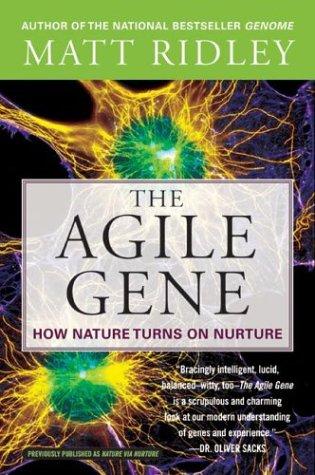
Talk to Nature via Nurture: Genes, Experience, and What Makes Us Human like its author wrote you back.
Get the ideas that fit your life — not generic summaries.
- Chat with the book
- Audiobook-style main ideas
- Adapts to your life and goals
- Helps you take action
Key takeaways
- 1.
Nature and nurture are not opposed forces. Genes respond to experience, and experience works through genetic mechanisms. The dichotomy itself is the error.
- 2.
Roughly half the variance in most behavioral traits traces to genetic differences, but those genetic effects are almost always conditional on specific environments.
- 3.
Gene-environment interactions are the norm. A gene for depression raises risk only in people who also experience stress; neither alone predicts much.
- 4.
The blank-slate doctrine — that human minds are infinitely malleable by culture — has dominated social science for decades despite accumulating contrary evidence.
- 5.
Twin studies remain the most powerful tool for separating genetic from environmental influence, and they consistently show substantial heritability for personality, intelligence, and psychopathology.
- 6.
Evolution has shaped human tendencies — aggression, language, kinship preference, status-seeking — but these tendencies express differently depending on culture and circumstance.
- 7.
Accepting that human nature exists does not mean accepting inequality as inevitable. Genetic influence defines ranges and tendencies, not fixed outcomes.
- 8.
The real insight from molecular genetics is that genes are not the opposite of learning — they are the mechanism of learning. Experience changes gene expression.
Discussion questions
Use these on your own, with a book club, or as chat starters in Superbook. Book club version, ready to copy or print →
- 1.
Ridley argues the nature-nurture binary was never scientifically valid. Where do you still encounter blank-slate or genetic-determinist thinking in everyday life?
- 2.
How does the concept of gene-environment interaction change the way you think about personal responsibility for behavior or mental health?
- 3.
Ridley suggests political ideology has distorted research on human nature. Can you think of a current debate where that distortion is still operating?
- 4.
If roughly half of personality variance is genetic, what does that imply for how parents should think about their role in shaping their children?
- 5.
The serotonin transporter example shows that genes matter only in certain environments. What does this mean for how we should design social policies or interventions?
- 6.
Ridley defends evolutionary psychology against critics who see it as deterministic. Do you find his defense convincing, and where does it fall short?
- 7.
Which of your own traits do you attribute primarily to your upbringing, and which feel more like stable predispositions? How sure are you?
- 8.
The book was published in 2003. How has the science of epigenetics and gene expression changed or reinforced Ridley's argument since then?
- 9.
What is the practical difference between saying a behavior is 50% heritable versus saying it is determined by genes? Does the distinction matter to you?
- 10.
Ridley argues that acknowledging genetic influence opens the door to smarter interventions. Can you think of an example where this logic has worked in practice?
- 11.
How do you respond to the idea that evolved human tendencies — like aggression or tribalism — are universal but not inevitable?
- 12.
If a person has a genetic predisposition to a mental illness, what obligation does society have toward them, and does the genetic framing change that obligation?
Themes
Frequently asked questions
-
What is Nature via Nurture actually about?
It argues that the nature versus nurture debate is a false dichotomy. Ridley shows how genes require environmental input to act, and how experience works through genetic mechanisms. The book reframes the question: not nature or nurture but nature activated via nurture.
-
Is this the same as Steven Pinker's The Blank Slate?
They cover similar ground — both push back against blank-slate environmentalism and defend the reality of human nature — but differ in scope and tone. Ridley focuses on the gene-environment interaction mechanism; Pinker's book is broader and more polemical about political implications.
-
Is Nature via Nurture worth reading?
Yes, particularly for readers who want a scientifically grounded account of how genes and environment actually interact, rather than a philosophical debate. The writing is clear and the examples are specific. Some of the molecular genetics has been updated by later research, but the central argument holds.
-
Who should read this book?
Anyone interested in behavioral genetics, evolutionary psychology, or the science behind personality and mental health. It is also useful for educators and policymakers who want to think more carefully about how environment and biology interact in human development.
-
What is the main weakness of the book?
Ridley wrote before the epigenetics revolution was fully established, and some readers find his dismissals of radical environmentalism overstated. The book is stronger as a correction to one extreme than as a complete account of the mechanisms it describes.
Similar books
Behave: The Biology of Humans at Our Best and Worst
Robert M. Sapolsky
The Selfish Gene
Richard Dawkins

Sapiens: A Brief History of Humankind
Yuval Noah Harari
The Gene: An Intimate History
Siddhartha Mukherjee
