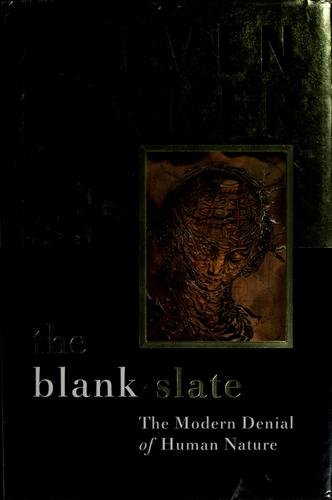
Talk to The Blank Slate: The Modern Denial of Human Nature like its author wrote you back.
Get the ideas that fit your life — not generic summaries.
- Chat with the book
- Audiobook-style main ideas
- Adapts to your life and goals
- Helps you take action
What it argues
The Blank Slate is Steven Pinker's comprehensive attack on what he calls the three linked doctrines that dominated twentieth-century thinking about human nature: the Blank Slate (the mind begins without innate content and is formed entirely by experience), the Noble Savage (humans are naturally peaceful and corrupted only by civilization), and the Ghost in the Machine (the mind is separable from the body and exempt from natural laws). Pinker, a cognitive scientist and linguist, argues that all three are empirically wrong and that their persistence in intellectual life has caused political and moral distortions across education, criminology, gender studies, and the arts.
The book's first half is an intellectual history and a marshaling of evidence. Pinker draws on behavior genetics, evolutionary psychology, cognitive neuroscience, and developmental psychology to argue that human minds come with substantial innate architecture: a language faculty, emotional responses, cognitive biases, moral intuitions, and dispositions toward violence, cooperation, and hierarchy. Twin and adoption studies show that shared environments (the home) explain almost none of the variance in adult personality — genes and unique individual experience explain nearly all of it.
What it gets right
- 1.
The Blank Slate, Noble Savage, and Ghost in the Machine are three interconnected doctrines about human nature that Pinker argues are empirically false and politically harmful.
- 2.
Behavior genetics research — especially twin and adoption studies — shows that shared environments explain almost none of adult personality variance. Genes and unique non-shared experiences explain nearly all of it.
- 3.
The mind is not a blank canvas shaped solely by culture. It comes with innate modules, instincts, and cognitive biases shaped by evolutionary pressures over hundreds of thousands of years.
What it covers
Who wrote it
Steven Pinker is a cognitive scientist and professor of psychology at Harvard University. He is the author of numerous books including The Language Instinct, How the Mind Works, The Better Angels of Our Nature, Enlightenment Now, and Rationality. His work spans language acquisition, visual cognition, and the history of violence. Pinker is known for combining evolutionary psychology, cognitive science, and statistical analysis with vigorous public argumentation. The Blank Slate, published in 2002, is his most polemical and wide-ranging book and remains a central text in debates about nature, nurture, and human nature.
