The Blank Slate: The Modern Denial of Human Nature by Steven Pinker is a 2002 science book about human nature, nature vs nurture, evolutionary psychology. The Blank Slate, Noble Savage, and Ghost in the Machine are three interconnected doctrines about human nature that Pinker argues are empirically false and politically harmful.
Summary
The Blank Slate is Steven Pinker's comprehensive attack on what he calls the three linked doctrines that dominated twentieth-century thinking about human nature: the Blank Slate (the mind begins without innate content and is formed entirely by experience), the Noble Savage (humans are naturally peaceful and corrupted only by civilization), and the Ghost in the Machine (the mind is separable from the body and exempt from natural laws). Pinker, a cognitive scientist and linguist, argues that all three are empirically wrong and that their persistence in intellectual life has caused political and moral distortions across education, criminology, gender studies, and the arts.
The book's first half is an intellectual history and a marshaling of evidence. Pinker draws on behavior genetics, evolutionary psychology, cognitive neuroscience, and developmental psychology to argue that human minds come with substantial innate architecture: a language faculty, emotional responses, cognitive biases, moral intuitions, and dispositions toward violence, cooperation, and hierarchy. Twin and adoption studies show that shared environments (the home) explain almost none of the variance in adult personality — genes and unique individual experience explain nearly all of it.
The second half turns to the political and moral stakes. Pinker argues that fear of genetic determinism — worry that acknowledging innate differences will justify oppression — has distorted policy and scholarship in ways that have real costs. He examines gender differences, parenting, violence, and the arts, and argues that a realistic account of human nature is compatible with, and in some ways supports, progressive moral commitments about equality and human dignity. He is at pains to separate "is" from "ought": acknowledging that humans have aggressive impulses doesn't justify acting on them.
The book is long and combative. Pinker has clear enemies in mind and spends considerable time scoring points against named academics and institutions. Some arguments feel rehearsed rather than fresh. But as a survey of what the cognitive and biological sciences had established about human nature by the early 2000s, it remains authoritative and has mostly aged well. Readers who engage with it in good faith will find their assumptions about nature and nurture productively disrupted.
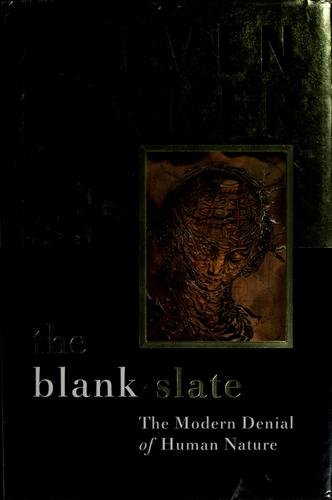
Talk to The Blank Slate: The Modern Denial of Human Nature like its author wrote you back.
Get the ideas that fit your life — not generic summaries.
- Chat with the book
- Audiobook-style main ideas
- Adapts to your life and goals
- Helps you take action
Key takeaways
- 1.
The Blank Slate, Noble Savage, and Ghost in the Machine are three interconnected doctrines about human nature that Pinker argues are empirically false and politically harmful.
- 2.
Behavior genetics research — especially twin and adoption studies — shows that shared environments explain almost none of adult personality variance. Genes and unique non-shared experiences explain nearly all of it.
- 3.
The mind is not a blank canvas shaped solely by culture. It comes with innate modules, instincts, and cognitive biases shaped by evolutionary pressures over hundreds of thousands of years.
- 4.
Human universals — features found in all cultures, including language, music, violence, reciprocity, and social hierarchies — are evidence for a common evolved human nature, not cultural construction.
- 5.
Fear of genetic determinism does not make determinism false. Acknowledging innate tendencies doesn't justify them. The naturalistic fallacy (is to ought) is the confusion most often made in these debates.
- 6.
Gender differences in psychology and behavior are real, distributed differently across averages and variances, and cannot be explained away by socialization alone, though socialization amplifies them.
- 7.
Traditional arts were sophisticated and morally complex because they grappled honestly with human nature. Modern institutional art that pretends human nature doesn't exist tends to be preachy and dull.
- 8.
Children are not shaped primarily by their parents' parenting style; peer groups, genes, and non-shared environments are more powerful predictors of who children become.
Discussion questions
Use these on your own, with a book club, or as chat starters in Superbook. Book club version, ready to copy or print →
- 1.
Pinker argues that the Blank Slate persists not because of evidence but because of political fears about what acknowledging human nature would justify. Do you find that claim convincing?
- 2.
The behavior genetics finding — that parenting style barely affects adult personality — is among the most disturbing in the book for many readers. What does it change, if true, about how you think about parenting?
- 3.
Pinker distinguishes between acknowledging that humans have aggressive impulses and endorsing those impulses. Do you think that distinction holds in practice in political debates?
- 4.
The book argues that human universals — things found in all cultures — are evidence for evolved human nature. Can you think of a potential universal that Pinker doesn't mention? One that seems genuinely absent in some cultures?
- 5.
Gender differences are one of the most contested sections. What is your prior belief about the origin of behavioral differences between men and women, and did reading this chapter shift it?
- 6.
If children are shaped more by peers and genes than by parenting, what should parents actually focus their energy on, in your view?
- 7.
Pinker argues that political progressivism has been distorted by the Blank Slate. Are there equivalent distortions he underweights on the political right?
- 8.
The naturalistic fallacy — inferring how things should be from how they are — is a recurring concern. Can you think of a real policy debate where you've seen this fallacy operating?
- 9.
The book was published in 2002. Which arguments have been strengthened by subsequent research? Which have been weakened or complicated?
- 10.
Pinker is a combative writer who names enemies and ridicules opposing positions. Does his rhetorical style affect your confidence in the underlying argument?
- 11.
The Noble Savage doctrine — that humans are naturally peaceful and corrupted only by civilization — was challenged by archaeological and anthropological evidence of pre-state violence. Does Pinker's account of violence in pre-state societies match what you expected?
- 12.
If innate human tendencies toward tribalism, in-group favoritism, and status competition are real, what institutions and practices can effectively counteract them?
Themes
Frequently asked questions
-
What is The Blank Slate about?
Pinker argues that humans are not born as blank slates shaped entirely by environment and culture. Drawing on cognitive science, evolutionary psychology, and behavior genetics, he makes the case that the human mind has substantial innate architecture, and that denying this has produced intellectual and political distortions with real costs.
-
Is The Blank Slate still worth reading?
Yes, though it benefits from being read alongside responses and subsequent research. The empirical core — on behavior genetics, innate cognitive structure, and human universals — has held up well. Some sections, particularly on gender, are more contested. As an introduction to the nature/nurture debate it remains one of the most thorough treatments available.
-
Who should read The Blank Slate?
Anyone seriously interested in human nature, psychology, evolutionary biology, political theory, or education policy. It is also essential reading for people who work in gender studies, criminology, or developmental psychology and want to engage honestly with the strongest version of the evolutionary psychology critique.
-
What is the most disturbing finding in The Blank Slate?
For many readers, the behavior genetics research: the finding that how parents raise their children — within the normal range — has almost no measurable effect on adult personality, values, or outcomes. Genes and non-shared environments (peer groups, unique experiences) explain nearly all of the variance.
-
How long does it take to read The Blank Slate?
At average reading pace, about ten to eleven hours. The book is over 500 pages. Pinker writes clearly but the content is dense in places. Most readers find the first half (the scientific case) moves faster than the second (the political and ethical implications), which requires more active engagement.
Similar books

Sapiens: A Brief History of Humankind
Yuval Noah Harari
Behave: The Biology of Humans at Our Best and Worst
Robert M. Sapolsky
Thinking, Fast and Slow
Daniel Kahneman

The Better Angels of Our Nature
Steven Pinker
