Talk to The Blind Watchmaker like its author wrote you back.
Get the ideas that fit your life — not generic summaries.
- Chat with the book
- Audiobook-style main ideas
- Adapts to your life and goals
- Helps you take action
The Blind Watchmaker, in detail
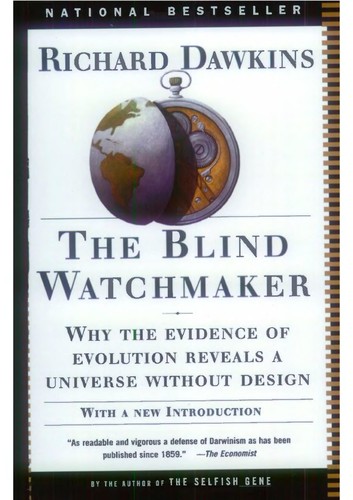
The Blind Watchmaker is Richard Dawkins's argument that natural selection — cumulative, non-random selection acting on random variation — is sufficient to explain the apparent design in biological organisms. The title is taken from William Paley's 1802 watchmaker analogy: Paley argued that just as a watch, with its intricate mechanisms, implies a watchmaker, so the complexity of organisms implies a designer. Dawkins's response is that the watchmaker is blind — there is no foresight, no purpose, no design — and that this lack of design does not make evolution's power any less real.
The book's central demonstration is cumulative selection. Dawkins distinguishes between single-step selection — the vanishingly improbable emergence of complexity in a single event — and cumulative selection, in which each small improvement is retained as the starting point for the next step. To make this concrete, he describes a computer program he wrote that begins with random letters and uses cumulative selection to converge on a target phrase. The program reaches "METHINKS IT IS LIKE A WEASEL" in about forty generations. The point is not that evolution has a target but that cumulative selection is astronomically more powerful than chance.
Dawkins surveys the adaptations that seem most improbable as products of gradual accumulation: the eye, bat echolocation, and the complexity of the cell. In each case, he reconstructs plausible evolutionary pathways — intermediate stages that would each have been functional and selectable. The eye, he argues, need not have evolved in one step; any light-sensitive patch is better than none, any improvement in focusing is selectable. Given sufficient time and generation turnover, the probability calculations shift dramatically.
The book also engages with creationism and its descendants, arguing that the appeal of design inferences is psychological rather than logical — the human brain is pattern-seeking and sees agency even where there is none. This argument about cognitive bias is a thread through Dawkins's work that connects evolutionary biology to epistemology.
The big ideas
- 1.
Cumulative selection is the key to understanding evolution: each small improvement is preserved and builds on the last, producing complexity in a process that is orders of magnitude more powerful than blind chance.
- 2.
The Weasel program demonstrates that cumulative selection can reach highly specific outcomes from random starting points in far fewer steps than single-step random search could ever achieve.
- 3.
The eye is not irreducibly complex: any light-sensitive patch is better than none, any improvement in imaging is selectable, and the range of actual eyes in nature — from simple pits to complex camera eyes — documents the progression.
