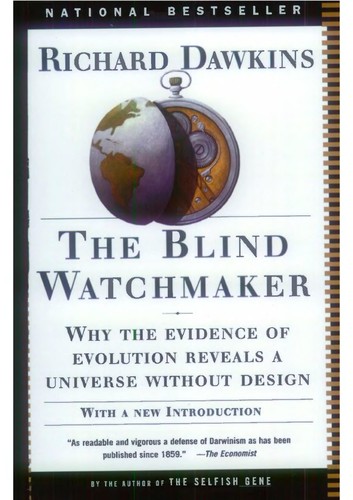
The Blind Watchmaker by Richard Dawkins is a 1986 science book about evolution, natural selection, complexity. Cumulative selection is the key to understanding evolution: each small improvement is preserved and builds on the last, producing complexity in a process that is orders of magnitude more powerful than blind chance.
Summary
The Blind Watchmaker is Richard Dawkins's argument that natural selection — cumulative, non-random selection acting on random variation — is sufficient to explain the apparent design in biological organisms. The title is taken from William Paley's 1802 watchmaker analogy: Paley argued that just as a watch, with its intricate mechanisms, implies a watchmaker, so the complexity of organisms implies a designer. Dawkins's response is that the watchmaker is blind — there is no foresight, no purpose, no design — and that this lack of design does not make evolution's power any less real.
The book's central demonstration is cumulative selection. Dawkins distinguishes between single-step selection — the vanishingly improbable emergence of complexity in a single event — and cumulative selection, in which each small improvement is retained as the starting point for the next step. To make this concrete, he describes a computer program he wrote that begins with random letters and uses cumulative selection to converge on a target phrase. The program reaches "METHINKS IT IS LIKE A WEASEL" in about forty generations. The point is not that evolution has a target but that cumulative selection is astronomically more powerful than chance.
Dawkins surveys the adaptations that seem most improbable as products of gradual accumulation: the eye, bat echolocation, and the complexity of the cell. In each case, he reconstructs plausible evolutionary pathways — intermediate stages that would each have been functional and selectable. The eye, he argues, need not have evolved in one step; any light-sensitive patch is better than none, any improvement in focusing is selectable. Given sufficient time and generation turnover, the probability calculations shift dramatically.
The book also engages with creationism and its descendants, arguing that the appeal of design inferences is psychological rather than logical — the human brain is pattern-seeking and sees agency even where there is none. This argument about cognitive bias is a thread through Dawkins's work that connects evolutionary biology to epistemology.
Talk to The Blind Watchmaker like its author wrote you back.
Get the ideas that fit your life — not generic summaries.
- Chat with the book
- Audiobook-style main ideas
- Adapts to your life and goals
- Helps you take action
Key takeaways
- 1.
Cumulative selection is the key to understanding evolution: each small improvement is preserved and builds on the last, producing complexity in a process that is orders of magnitude more powerful than blind chance.
- 2.
The Weasel program demonstrates that cumulative selection can reach highly specific outcomes from random starting points in far fewer steps than single-step random search could ever achieve.
- 3.
The eye is not irreducibly complex: any light-sensitive patch is better than none, any improvement in imaging is selectable, and the range of actual eyes in nature — from simple pits to complex camera eyes — documents the progression.
- 4.
Bat echolocation — the biological sonar that allows bats to hunt moths in total darkness — is an example of biological 'technology' that natural selection has refined to extraordinary precision over millions of generations.
- 5.
The probability argument against evolution (a 747 assembled by a whirlwind in a junkyard) is a misunderstanding of what cumulative selection does; the relevant question is never whether complexity could arise by chance in one step.
- 6.
Evolution has no foresight and no direction; adaptations are solutions to the ancestral environment, not preparations for the future, which is why species are so poorly adapted to changed conditions.
- 7.
The appearance of design in nature is a powerful illusion that our pattern-seeking minds generate; recognizing it as an illusion produced by a known process is one of evolution's most profound contributions to human understanding.
- 8.
Gradualism — the idea that complex adaptations evolved through many small steps — is not a faith position but a logical implication of cumulative selection; saltatory evolution of complex organs has no plausible mechanism.
Discussion questions
Use these on your own, with a book club, or as chat starters in Superbook. Book club version, ready to copy or print →
- 1.
Dawkins distinguishes cumulative selection from single-step selection. Did that distinction change your intuitions about the plausibility of evolution?
- 2.
The Weasel program is a famous demonstration that its critics say is misleading because it has a target. How well does Dawkins answer that objection?
- 3.
He argues the eye is not irreducibly complex. Which biological structure do you think poses the strongest genuine challenge to a gradualist account?
- 4.
Dawkins is explicit that evolution is purposeless and has no direction. Does that purposelessness matter to you philosophically or emotionally?
- 5.
The book engages directly with creationism and design arguments. Is that engagement respectful? Does it strengthen or weaken the scientific case?
- 6.
He argues the appearance of design is a cognitive illusion produced by our pattern-seeking brains. If that's right, what other illusions might we be subject to for the same reason?
- 7.
Echolocation in bats evolved independently in similar form in dolphins and some birds. What does convergent evolution tell us about the nature of evolutionary possibility?
- 8.
The book uses computer simulations to illustrate evolutionary principles. How confident are you in that kind of model-based argument?
- 9.
Dawkins argues that once you understand cumulative selection, design arguments become unpersuasive. Is that true for you personally?
- 10.
How does The Blind Watchmaker relate to The Selfish Gene? Are they making the same argument at different levels of description?
- 11.
Is Dawkins's tone — confident, combative — appropriate for a book whose primary argument is scientific? Does it help or hurt the case he's making?
- 12.
The book was written in 1986. What developments in evolutionary biology since then have most strengthened or complicated its argument?
Themes
Frequently asked questions
-
Is The Blind Watchmaker a response to intelligent design?
It was written before the intelligent design movement formally organized, but it addresses the same arguments that ID would later deploy. Paley's watchmaker analogy, which Dawkins takes as his starting point, is the same argument ID proponents use. The book is the most thorough pre-emptive refutation of design arguments ever written.
-
Do I need to know biology to read it?
No. Dawkins explains all the relevant concepts. Some readers find the echolocation and cell biology chapters technically dense, but the central argument about cumulative selection is accessible without prior knowledge.
-
Is Dawkins fair to the people he disagrees with?
That is contested. Scientists who make the same arguments are treated charitably; creationists and design theorists are handled more roughly. Some readers find his tone appropriately direct; others find it dismissive. The scientific argument is largely independent of the tone.
-
What is the blind watchmaker metaphor?
Paley argued in 1802 that the complexity of a watch implies a watchmaker, and the complexity of organisms similarly implies a designer. Dawkins's response is that natural selection is a watchmaker of sorts — it produces complex adaptation — but is blind: it has no foresight, no purpose, and no design. The complexity is real; the designer is not.
-
How does it differ from The Selfish Gene?
The Selfish Gene argues that genes are the unit of selection and explains evolution from that perspective. The Blind Watchmaker focuses on defending gradual evolution against the claim that complexity requires design. They complement each other but address different audiences and different objections.