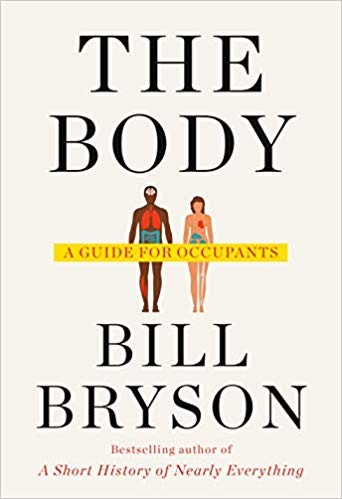
Talk to The Body: A Guide for Occupants like its author wrote you back.
Get the ideas that fit your life — not generic summaries.
- Chat with the book
- Audiobook-style main ideas
- Adapts to your life and goals
- Helps you take action
The Body: A Guide for Occupants, in detail
Bill Bryson turns his signature wide-lens curiosity on the human body, covering it organ by organ, system by system, from the skin inward. Each chapter combines the basic science of how a body part works with the history of how medicine came to understand it, laced with statistics, oddities, and the occasional unnerving reminder that the whole enterprise is more precarious than it feels.
Bryson's central theme, if one can call it that, is astonishment. The human body does extraordinary things without asking for permission: the heart beats three billion times over a lifetime, the immune system identifies and destroys pathogens it has never encountered before, the brain hums with activity for decades on a daily energy budget of about 400 calories. He is particularly good at conveying scale — how many bacteria live on and in us, how much of our DNA is viral in origin, how staggeringly small a cell is and yet how much is happening inside it.
The book does not push a thesis. It is not an argument for any particular diet or lifestyle. Bryson is skeptical of medical certainty throughout, noting how often science has reversed itself and how much of what drives health outcomes remains poorly understood. He treats medicine as a young and sometimes chaotic field more than a settled science. The nutritional chapters in particular land as a long catalog of things researchers thought they knew and turned out not to.
For a reader with no background in biology or medicine, The Body is an excellent orientation — readable, funny in places, and genuinely surprising. Those with scientific training may find the coverage too broad to be illuminating, though the historical sections hold up regardless. Bryson is honest about his limitations as an explainer of cutting-edge research, and that honesty is itself informative. We understand less about the bodies we live in than we commonly assume.
The big ideas
- 1.
The human body operates at scales of complexity that defy easy summary: trillions of cells, a microbiome with more bacterial cells than human ones, and organ systems that run in parallel without central coordination.
- 2.
Medicine has a short history of actually working. Many treatments used confidently for centuries caused more harm than good, and the science of nutrition remains surprisingly contested.
- 3.
The immune system is both more sophisticated and more dangerous than most people appreciate — it can eliminate novel pathogens but also attack the body's own tissue.
