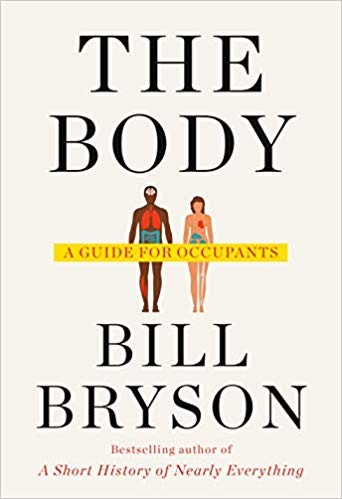
The Body: A Guide for Occupants by Bill Bryson is a 2019 science book about human biology, medicine, anatomy. The human body operates at scales of complexity that defy easy summary: trillions of cells, a microbiome with more bacterial cells than human ones, and organ systems that run in parallel without central coordination.
Summary
Bill Bryson turns his signature wide-lens curiosity on the human body, covering it organ by organ, system by system, from the skin inward. Each chapter combines the basic science of how a body part works with the history of how medicine came to understand it, laced with statistics, oddities, and the occasional unnerving reminder that the whole enterprise is more precarious than it feels.
Bryson's central theme, if one can call it that, is astonishment. The human body does extraordinary things without asking for permission: the heart beats three billion times over a lifetime, the immune system identifies and destroys pathogens it has never encountered before, the brain hums with activity for decades on a daily energy budget of about 400 calories. He is particularly good at conveying scale — how many bacteria live on and in us, how much of our DNA is viral in origin, how staggeringly small a cell is and yet how much is happening inside it.
The book does not push a thesis. It is not an argument for any particular diet or lifestyle. Bryson is skeptical of medical certainty throughout, noting how often science has reversed itself and how much of what drives health outcomes remains poorly understood. He treats medicine as a young and sometimes chaotic field more than a settled science. The nutritional chapters in particular land as a long catalog of things researchers thought they knew and turned out not to.
For a reader with no background in biology or medicine, The Body is an excellent orientation — readable, funny in places, and genuinely surprising. Those with scientific training may find the coverage too broad to be illuminating, though the historical sections hold up regardless. Bryson is honest about his limitations as an explainer of cutting-edge research, and that honesty is itself informative. We understand less about the bodies we live in than we commonly assume.
Talk to The Body: A Guide for Occupants like its author wrote you back.
Get the ideas that fit your life — not generic summaries.
- Chat with the book
- Audiobook-style main ideas
- Adapts to your life and goals
- Helps you take action
Key takeaways
- 1.
The human body operates at scales of complexity that defy easy summary: trillions of cells, a microbiome with more bacterial cells than human ones, and organ systems that run in parallel without central coordination.
- 2.
Medicine has a short history of actually working. Many treatments used confidently for centuries caused more harm than good, and the science of nutrition remains surprisingly contested.
- 3.
The immune system is both more sophisticated and more dangerous than most people appreciate — it can eliminate novel pathogens but also attack the body's own tissue.
- 4.
Sleep is among the least understood of the body's functions, yet its absence degrades nearly every system measurably.
- 5.
The brain consumes a disproportionate share of the body's energy and remains largely mysterious: we can map its regions but understand little about how consciousness arises from it.
- 6.
Genetics explains less about disease than the popular imagination suggests. Most conditions are multifactorial, and environment and behavior interact with genes in ways that are difficult to isolate.
- 7.
The body's default response to most threats is inflammation, which is adaptive in the short term and damaging over the long term when chronically activated.
- 8.
Cancer is fundamentally a disease of mutation and replication error. The wonder is not that it occurs but that it doesn't occur far more often.
Discussion questions
Use these on your own, with a book club, or as chat starters in Superbook. Book club version, ready to copy or print →
- 1.
Bryson emphasizes how much about the human body remains unknown. Did that surprise you? Does it change how you think about medical advice?
- 2.
The book suggests that our confidence in nutritional science is often misplaced. How do you decide which dietary advice to follow, given how often expert consensus changes?
- 3.
Bryson is clearly delighted by the body's complexity. What single fact or system in the book struck you as most remarkable?
- 4.
The immune system protects us but can also cause autoimmune disease. How do you think about that double-edged quality in other complex systems — political, ecological, social?
- 5.
The book covers how long medicine was largely ineffective. Does knowing that history change your relationship with doctors or medical institutions today?
- 6.
Bryson treats the microbiome as an emerging field with more questions than answers. How comfortable are you with acting on advice about gut health given that uncertainty?
- 7.
The chapters on sleep suggest it is irreplaceable. How does your actual sleep behavior square with what Bryson describes as its importance?
- 8.
Bryson doesn't moralize much, but the book implicitly raises questions about lifestyle and health. Do you find his non-prescriptive approach refreshing or frustrating?
- 9.
Cancer is described as a near-inevitable byproduct of cellular replication at scale. Does framing it that way change how you think about prevention versus luck?
- 10.
The book covers the history of medicine's failures as well as its successes. What does that arc suggest about which current certainties we should hold lightly?
- 11.
Where in your daily life do you most take your body for granted? Did the book shift that at all?
- 12.
Bryson writes with humor about things like digestion and cellular death. Does that tone feel appropriate for the subject, or does it sometimes undercut the seriousness?
Themes
Frequently asked questions
-
Is The Body by Bill Bryson worth reading?
Yes, for readers who want a broad, entertaining tour of human biology without needing a science background. Bryson is a skilled synthesizer and a funny writer. Those wanting deep dives into specific systems or current research will need additional sources.
-
How long is The Body?
Around 450 pages, roughly seven to eight hours of reading. The chapters are self-contained enough that you can read it in sections rather than straight through.
-
What is The Body about?
It covers the human body organ by organ and system by system, combining basic biology with medical history, surprising statistics, and honest acknowledgment of how much remains poorly understood. It does not argue for a particular health approach.
-
Who should read The Body?
Curious non-specialists who want to understand their own biology without sitting through a textbook. It works well for book clubs because almost every chapter raises a conversation-starting question. Scientists may find the coverage thin.
-
Does The Body give health advice?
Not really. Bryson is more interested in explaining and contextualizing than prescribing. The implicit message is that the body is remarkable, medicine is imperfect, and much of what we think we know about nutrition and lifestyle is shakier than it looks.