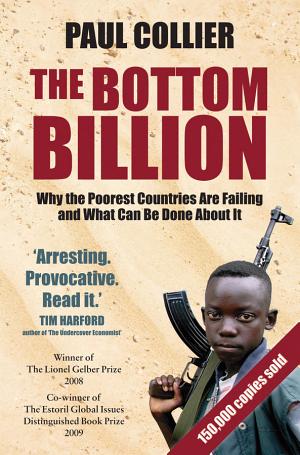
Talk to The Bottom Billion: Why the Poorest Countries Are Failing and What Can Be Done About It like its author wrote you back.
Get the ideas that fit your life — not generic summaries.
- Chat with the book
- Audiobook-style main ideas
- Adapts to your life and goals
- Helps you take action
What it argues
Paul Collier spent two decades as a development economist at the World Bank and Oxford before writing The Bottom Billion, and the book reflects that experience in a specific way: rather than offering a unified theory of why poor countries stay poor, it offers a careful, empirically grounded account of the different mechanisms — the traps — that keep the roughly fifty countries and one billion people in the most severe and persistent poverty from breaking out.
Collier identifies four main traps: the conflict trap, in which civil wars destroy growth and leave countries vulnerable to further conflict; the natural resource trap, in which commodity wealth enriches elites and undermines institutional development; the landlocked trap, in which geography cuts countries off from global trade and development; and the bad governance trap, in which poor institutions prevent the growth that would fund better governance. Each trap has its own logic and, in Collier's account, its own policy implications. Not every poor country is stuck in the same way, and solutions have to match the specific trap.
What it gets right
- 1.
The poorest billion people are not uniformly trapped by the same mechanism. Different traps — conflict, resource curse, landlocked geography, bad governance — require different policy responses.
- 2.
Civil wars are driven more by economic opportunity (access to lootable resources) than by ethnic or political grievance, according to Collier's quantitative research. This finding has significant implications for conflict prevention.
- 3.
The resource curse is real: countries that discover natural resource wealth before developing effective institutions tend to see that wealth captured by elites and converted into conflict rather than development.
What it covers
Who wrote it
Paul Collier is a professor of economics and public policy at the Blavatnik School of Government at Oxford University and the director of the International Growth Centre. He spent two decades as a research economist and director of development research at the World Bank. His quantitative work on the economics of civil war and the resource curse has been highly influential in development economics and conflict studies. His other books include Wars, Guns, and Votes and Exodus: How Migration Is Changing Our World. He was knighted in 2014 for services to economics.
