The Bottom Billion: Why the Poorest Countries Are Failing and What Can Be Done About It by Paul Collier is a 2007 economics book about development economics, poverty traps, conflict. The poorest billion people are not uniformly trapped by the same mechanism. Different traps — conflict, resource curse, landlocked geography, bad governance — require different policy responses.
Summary
Paul Collier spent two decades as a development economist at the World Bank and Oxford before writing The Bottom Billion, and the book reflects that experience in a specific way: rather than offering a unified theory of why poor countries stay poor, it offers a careful, empirically grounded account of the different mechanisms — the traps — that keep the roughly fifty countries and one billion people in the most severe and persistent poverty from breaking out.
Collier identifies four main traps: the conflict trap, in which civil wars destroy growth and leave countries vulnerable to further conflict; the natural resource trap, in which commodity wealth enriches elites and undermines institutional development; the landlocked trap, in which geography cuts countries off from global trade and development; and the bad governance trap, in which poor institutions prevent the growth that would fund better governance. Each trap has its own logic and, in Collier's account, its own policy implications. Not every poor country is stuck in the same way, and solutions have to match the specific trap.
The book is explicitly addressed to Western policymakers and citizens, and it argues for more active engagement rather than disengagement. Collier supports targeted military intervention in some post-conflict situations, reform-conditioned aid for governance traps, and trade policy changes that would allow the bottom billion to access rich-country markets. His prescriptions are politically heterodox, combining what might be considered liberal (aid) and conservative (military intervention, conditionality) positions without ideological consistency — which he regards as a feature, not a bug, of evidence-based policymaking.
Collier is more sympathetic to aid than Easterly while sharing Easterly's concern about accountability and evidence. His strongest chapters are on the conflict trap, where his own quantitative research on the economics of civil war produced the finding that conflicts are driven more by economic opportunity — particularly the ability to loot natural resources — than by grievance, which reversed how many development organizations thought about conflict prevention. The book is short, clearly argued, and carries the weight of serious empirical research.
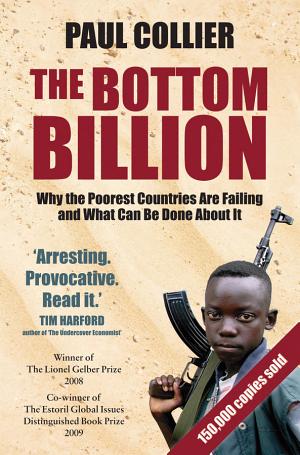
Talk to The Bottom Billion: Why the Poorest Countries Are Failing and What Can Be Done About It like its author wrote you back.
Get the ideas that fit your life — not generic summaries.
- Chat with the book
- Audiobook-style main ideas
- Adapts to your life and goals
- Helps you take action
Key takeaways
- 1.
The poorest billion people are not uniformly trapped by the same mechanism. Different traps — conflict, resource curse, landlocked geography, bad governance — require different policy responses.
- 2.
Civil wars are driven more by economic opportunity (access to lootable resources) than by ethnic or political grievance, according to Collier's quantitative research. This finding has significant implications for conflict prevention.
- 3.
The resource curse is real: countries that discover natural resource wealth before developing effective institutions tend to see that wealth captured by elites and converted into conflict rather than development.
- 4.
Landlocked countries dependent on their neighbors' infrastructure face structural barriers to growth that neither domestic policy nor aid can fully overcome without regional cooperation.
- 5.
Post-conflict periods are windows of genuine opportunity for international intervention, but only if the intervention is sustained for long enough — roughly a decade — to allow institutions to stabilize.
- 6.
Trade preferences for the bottom billion matter more than aid volume. Allowing these countries access to rich-country markets would do more for their long-term growth than most aid programs.
- 7.
The governance trap is the hardest to escape because better governance requires resources that growth alone can provide, creating a genuine catch-22 that external support may need to break.
- 8.
Aid works differently in different contexts. In post-conflict situations with improving governance it can be highly effective; in bad governance situations without reform it is largely wasted.
Discussion questions
Use these on your own, with a book club, or as chat starters in Superbook. Book club version, ready to copy or print →
- 1.
Collier distinguishes four traps rather than one unified theory of poverty. Does that analytical granularity make his prescriptions more or less convincing than a single-cause account?
- 2.
The finding that civil wars are driven by economic opportunity rather than grievance was deeply counterintuitive when published. What would it imply for how development organizations think about conflict prevention?
- 3.
Collier supports targeted military intervention in post-conflict countries. How do you evaluate that position, and what conditions would need to be met for it to be justified?
- 4.
The resource curse suggests that discovering natural wealth can make a country worse off. What institutional conditions would need to exist for resource wealth to be a genuine benefit?
- 5.
Collier is more supportive of aid than Easterly while sharing his concern about accountability. Where exactly do their positions diverge, and how do you weigh their disagreement?
- 6.
Trade preferences rather than aid are presented as the more powerful tool for long-term development. What political obstacles in rich countries make that shift difficult?
- 7.
The landlocked trap seems the least addressable by policy. Does that imply anything about which countries development organizations should prioritize?
- 8.
Collier addresses his argument explicitly to Western voters and policymakers. How does that rhetorical choice shape what he argues and what he leaves out?
- 9.
The post-conflict window of opportunity requires a decade of sustained engagement. What has been the track record of that kind of sustained commitment in practice?
- 10.
If the bottom billion's problems are primarily structural rather than a function of insufficient aid, what does that imply about the effectiveness of individual charitable giving?
- 11.
Collier combines positions typically associated with different political camps. Does that cross-cutting approach strengthen or weaken his credibility in a polarized debate?
- 12.
Which of the four traps do you find most compelling as an explanation of persistent poverty, and which do you find least supported by the evidence Collier presents?
Themes
Frequently asked questions
-
What is The Bottom Billion about?
It is an account of why roughly fifty countries with about one billion people remain stuck in severe and persistent poverty despite decades of development efforts. Collier identifies four structural traps — conflict, natural resources, landlocked geography, and bad governance — and argues each requires different policy responses.
-
Is The Bottom Billion worth reading?
Yes, particularly for anyone interested in global poverty, development policy, or why international aid produces such variable results. Collier's empirical grounding and willingness to reach politically heterodox conclusions make it more credible than most advocacy-driven accounts.
-
How long does it take to read?
About five hours at average reading pace. The book is approximately 225 pages, written accessibly and structured around the four traps framework. It is one of the shorter serious books on development economics.
-
How does Collier's view of aid differ from Easterly's?
Collier is more conditional: he thinks aid can work in specific contexts, particularly post-conflict situations with improving governance, but is largely ineffective in bad-governance situations. Easterly is more skeptical across the board. Both emphasize accountability and the importance of measuring outcomes.
-
What is the most important idea in The Bottom Billion?
The conflict trap findings — that civil wars are driven more by economic opportunity than by grievance — because they overturn a widespread assumption in how conflict is analyzed and how prevention resources are allocated. If loot is more important than grievance, the policy implications are substantially different.
Similar books
The White Man's Burden: Why the West's Efforts to Aid the Rest Have Done So Much Ill and So Little Good
William Easterly
Sapiens: A Brief History of Humankind
Yuval Noah Harari

Guns, Germs, and Steel
Jared Diamond
Freakonomics
Steven D. Levitt and Stephen J. Dubner
