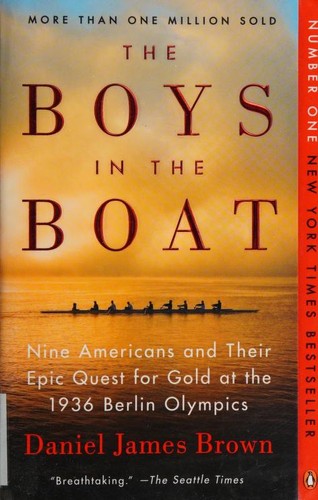
Talk to The Boys in the Boat: Nine Americans and Their Epic Quest for Gold at the 1936 Berlin Olympics like its author wrote you back.
Get the ideas that fit your life — not generic summaries.
- Chat with the book
- Audiobook-style main ideas
- Adapts to your life and goals
- Helps you take action
The Boys in the Boat: Nine Americans and Their Epic Quest for Gold at the 1936 Berlin Olympics, in detail
The Boys in the Boat is the story of the University of Washington crew team that won the gold medal at the 1936 Berlin Olympics, defeating Nazi Germany's squad on Hitler's home course. Daniel James Brown focuses primarily on Joe Rantz, a rower who had been effectively abandoned by his family during the Great Depression and who found, in the boat, a form of belonging he had never known. The book moves between Rantz's personal history, the technical world of competitive rowing, and the political theater of the Berlin Games.
Brown's portrait of Depression-era Washington State is one of the book's most affecting elements. These were not boys from wealthy families, as most college rowers of the era were. Many had worked in lumber camps and on farms, living in poverty while maintaining eligibility. Al Ulbrickson, their coach, is drawn as a reserved, demanding figure who saw in the Washington crew a particular quality — something beyond individual talent — that became visible only when all nine men found what the master boatbuilder George Pocock called "swing": the moment when individual effort disappears into collective motion.
The Berlin section introduces the political context with appropriate weight but does not overwhelm the sports narrative. Brown documents the Nazi staging of the Games — the removal of antisemitic signs, the theatrical pageantry — while keeping attention on the water. The American crew's path to the final involved illness, lane disadvantage, and a slow start that made their eventual win seem impossible until the final strokes.
Brown is a skilled storyteller working with genuinely compelling material, and the book has been a major commercial success. It occasionally shades toward sentimentality — particularly in the framing around Joe Rantz and the idea of the boat as family — but the rowing sequences are some of the most technically vivid in popular sports literature. Readers who respond to stories about teamwork, working-class grit, and the particular discipline of a sport that requires the complete subordination of individual ego will find it rewarding.
The big ideas
- 1.
Competitive rowing at the elite level requires the subordination of individual timing to collective rhythm. 'Swing' — the condition Pocock described — is both a technical and a psychological state.
- 2.
The 1936 Washington crew was composed almost entirely of working-class boys from the Pacific Northwest who had been shaped by Depression poverty, logging work, and physical labor rather than prep school training.
- 3.
George Pocock, the English-born boatbuilder who made the Washington shells, served as a mentor to Joe Rantz and articulated a philosophy of rowing that the book treats as its moral center.
