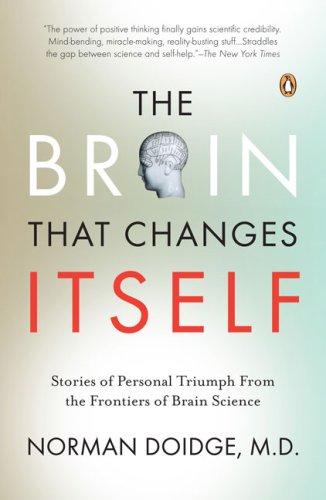
Talk to The Brain That Changes Itself like its author wrote you back.
Get the ideas that fit your life — not generic summaries.
- Chat with the book
- Audiobook-style main ideas
- Adapts to your life and goals
- Helps you take action
What it argues
Norman Doidge is a Canadian psychiatrist who traveled to interview the scientists and patients at the frontier of neuroplasticity research in the mid-2000s. His book, published in 2007, introduced the concept to a wide audience through case studies rather than lectures — a woman born with only one hemisphere of her brain who developed near-normal function, a man who rewired his obsessive sexual fantasies, a stroke patient who learned to walk again after doctors said she never would.
The central claim is that the brain is not fixed. For most of the twentieth century, the dominant view was that the adult brain's structure was essentially permanent — that the neural circuits you had at maturity were the ones you would die with. The neuroplasticity researchers Doidge profiles challenged this view from multiple directions: Merzenich on cortical remapping, Taub on constraint-induced movement therapy, Bach-y-Rita on sensory substitution. Their work showed that the brain's maps could be redrawn by experience, that unused circuits could be repurposed, and that recovery from damage was possible far beyond what had been assumed.
What it gets right
- 1.
The adult brain is far more changeable than the twentieth century assumed. Cortical maps can be redrawn by experience at any age, though plasticity decreases somewhat after critical developmental periods.
- 2.
Constraint-induced movement therapy — forcing the use of a damaged limb by immobilizing the good one — exploits plasticity to recover function after stroke. Edward Taub's work established this against fierce resistance.
- 3.
Sensory substitution is possible. Bach-y-Rita showed that the brain can learn to process spatial information sent through skin rather than vision, demonstrating that the brain processes information, not specific sensory modalities.
What it covers
Who wrote it
Norman Doidge is a Canadian psychiatrist, psychoanalyst, and author based in Toronto and New York. He is a faculty member of the University of Toronto's Department of Psychiatry and the Columbia University Center for Psychoanalytic Training and Research. The Brain That Changes Itself was an international bestseller and has been translated into more than twenty languages. His follow-up, The Brain's Way of Healing, extends the plasticity framework to conditions including Parkinson's disease and chronic pain. He writes and lectures on neuroplasticity, psychoanalysis, and the mind-body relationship.
