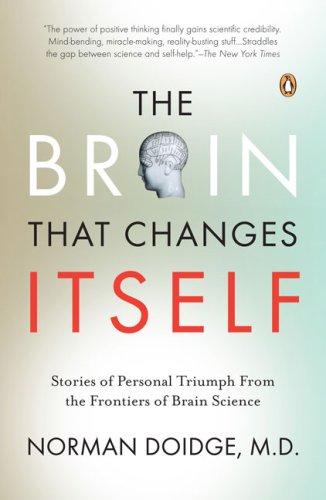
The Brain That Changes Itself by Norman Doidge is a 2007 psychology book about neuroplasticity, brain science, recovery. The adult brain is far more changeable than the twentieth century assumed. Cortical maps can be redrawn by experience at any age, though plasticity decreases somewhat after critical developmental periods.
Summary
Norman Doidge is a Canadian psychiatrist who traveled to interview the scientists and patients at the frontier of neuroplasticity research in the mid-2000s. His book, published in 2007, introduced the concept to a wide audience through case studies rather than lectures — a woman born with only one hemisphere of her brain who developed near-normal function, a man who rewired his obsessive sexual fantasies, a stroke patient who learned to walk again after doctors said she never would.
The central claim is that the brain is not fixed. For most of the twentieth century, the dominant view was that the adult brain's structure was essentially permanent — that the neural circuits you had at maturity were the ones you would die with. The neuroplasticity researchers Doidge profiles challenged this view from multiple directions: Merzenich on cortical remapping, Taub on constraint-induced movement therapy, Bach-y-Rita on sensory substitution. Their work showed that the brain's maps could be redrawn by experience, that unused circuits could be repurposed, and that recovery from damage was possible far beyond what had been assumed.
Doidge writes in long case study chapters that follow both the scientists and the patients. This is a feature, not a limitation — the stories make complex neuroscience concrete and give the research stakes it might otherwise lack. He is also interested in the dark side of plasticity: the same mechanisms that allow the brain to change for better allow it to change for worse, deepening addictions, cementing traumatic responses, and locking people into compulsive behaviors that they cannot simply decide to stop.
The book is somewhat dated in its enthusiasm. Some of the claims about neuroplasticity were overstated relative to what subsequent research has confirmed, and the more sensational passages have attracted criticism. But as a popular account of a genuine scientific revolution, it remains valuable. The core insight — that experience changes brain structure, and that structured experience can therefore change it deliberately — is well established and has shaped rehabilitation medicine, education, and addiction treatment.
Talk to The Brain That Changes Itself like its author wrote you back.
Get the ideas that fit your life — not generic summaries.
- Chat with the book
- Audiobook-style main ideas
- Adapts to your life and goals
- Helps you take action
Key takeaways
- 1.
The adult brain is far more changeable than the twentieth century assumed. Cortical maps can be redrawn by experience at any age, though plasticity decreases somewhat after critical developmental periods.
- 2.
Constraint-induced movement therapy — forcing the use of a damaged limb by immobilizing the good one — exploits plasticity to recover function after stroke. Edward Taub's work established this against fierce resistance.
- 3.
Sensory substitution is possible. Bach-y-Rita showed that the brain can learn to process spatial information sent through skin rather than vision, demonstrating that the brain processes information, not specific sensory modalities.
- 4.
Plasticity has a dark side. The same mechanisms that allow recovery from damage also allow addiction to deepen, trauma to consolidate, and compulsive behaviors to become self-reinforcing.
- 5.
Neuroplasticity is competitive. When one sense is impaired, cortex normally devoted to it is often reclaimed by other systems — a process Doidge documents in cases of blindness and deafness.
- 6.
Mental activity changes brain structure. Extended practice — of a motor skill, a language, a musical instrument — produces measurable changes in the cortical areas devoted to that activity.
- 7.
Pharmaceutical treatments and neuroplasticity-based treatments work through different mechanisms and are often complementary. Treating the brain as a fixed organ that needs a chemical fix misses what training and rehabilitation can do.
- 8.
Recovery from severe neurological damage is possible far beyond the limits medicine had set. The stories in this book demonstrate that assumptions about permanent damage often reflected the limits of existing rehabilitation methods, not of the brain.
Discussion questions
Use these on your own, with a book club, or as chat starters in Superbook. Book club version, ready to copy or print →
- 1.
Doidge's central message is that the brain can change throughout life. Has that idea changed how you think about anything — a habit, a skill, a limitation you have accepted?
- 2.
The book describes patients who recovered function after damage that was considered permanent. What does that say about how medicine should communicate prognosis to patients?
- 3.
He discusses the dark side of plasticity — addiction, obsessive sexual behavior, PTSD. How does the same mechanism produce both recovery and entrenchment?
- 4.
Doidge writes about competitive plasticity: when the brain is deprived of input from one system, it repurposes that cortex. What does that suggest about the use-it-or-lose-it principle in cognitive development?
- 5.
Several of the patients in the book recovered by finding workarounds — using a different neural pathway than the damaged one. How does that principle apply to learning in non-medical contexts?
- 6.
The book was criticized for overstating some plasticity claims. How do you weigh that against the value of accessible science writing? Where is the line between simplification and distortion?
- 7.
Merzenich's work on cognitive training programs has been commercially applied in products like Lumosity. How skeptical are you about the translation from laboratory research to commercial applications?
- 8.
Doidge describes patients who changed their brains through mental practice alone — without physical activity. Does that surprise you? What does it suggest about the relationship between mind and body?
- 9.
What cognitive or physical capacity would you most want to develop, and what would a genuinely neuroplasticity-informed training program for that capacity look like?
- 10.
The book was published in 2007 and was enormously popular. How has the public understanding of neuroplasticity changed since then — and where do you think it has overcorrected?
- 11.
He argues that plasticity declines but does not disappear with age. How does that intersect with your own assumptions about what you can still learn or change in yourself?
- 12.
What is the most practically useful idea you took from the cases in this book?
Themes
Frequently asked questions
-
Is the neuroscience in The Brain That Changes Itself accurate?
Mostly, with some exaggeration. The core concept of neuroplasticity is well established. Some specific claims — particularly about the extent to which adult plasticity matches developmental plasticity — were stated more strongly than subsequent research has confirmed. Read it as popular science that captures a real revolution while sometimes overstating its scope.
-
What is neuroplasticity?
The brain's ability to change its structure and function in response to experience. This includes forming new synaptic connections, strengthening existing ones, and reassigning cortical territory that is no longer in use to other functions.
-
Is it too late to benefit from neuroplasticity as an adult?
Doidge argues no. Adult plasticity is less dramatic than developmental plasticity, but it is real. The evidence for rehabilitation after stroke, recovery from sensory loss, and skill acquisition in adults all demonstrate that the adult brain continues to change.
-
What is the most important case study in the book?
Readers most often cite Cheryl, who was born without functional vestibular systems — she had no sense of balance — and learned to use a device that delivered balance information through her tongue. Her recovery demonstrates sensory substitution and the brain's flexibility about what modality carries what information.
-
Who should read this book?
Anyone interested in rehabilitation medicine, education, addiction, or what the brain can do. Also valuable for people who have been told a deficit or damage is permanent and want to understand what the evidence actually says about recovery.
Similar books
How Emotions Are Made: The Secret Life of the Brain
Lisa Feldman Barrett

The Man Who Mistook His Wife for a Hat
Oliver Sacks

Incognito: The Secret Lives of the Brain
David Eagleman

A Mind for Numbers
Barbara Oakley
