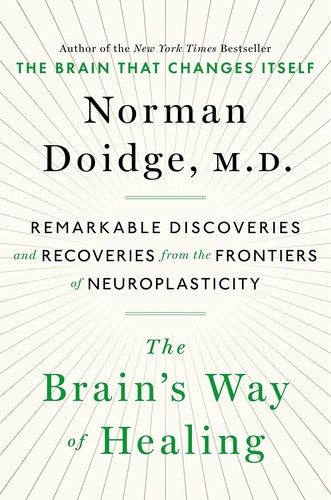
Talk to The Brain's Way of Healing like its author wrote you back.
Get the ideas that fit your life — not generic summaries.
- Chat with the book
- Audiobook-style main ideas
- Adapts to your life and goals
- Helps you take action
What it argues
The Brain's Way of Healing is Norman Doidge's follow-up to The Brain That Changes Itself and extends its central argument: the brain retains significant capacity to reorganize itself throughout life, and this plasticity can be deliberately harnessed to treat conditions that conventional medicine has largely written off as permanent. Doidge is a psychiatrist, not a neuroscientist, and writes as a journalist examining clinicians and researchers who have achieved surprising results using movement, light, sound, and thought to drive brain change.
The book opens with a chapter on pain that remains its strongest section. Doidge examines the work of Michael Moskowitz, a pain specialist who, after suffering a water-skiing injury, used his own knowledge of neuroplasticity to retrain his brain's response to chronic pain. The key insight is that chronic pain involves a brain that has learned to generate a pain signal continuously — it is a form of neural habit. If pain is a learned pattern rather than a structural fact, it can in principle be unlearned. Moskowitz taught himself to visualize his brain areas associated with pain shrinking whenever pain spiked, and over months reduced a severe chronic pain condition that conventional treatments had not touched.
What it gets right
- 1.
Neuroplasticity — the brain's capacity to reorganize in response to experience — extends throughout life, not just childhood, and applies to recovery from illness and injury, not just learning.
- 2.
Chronic pain is often a learned pattern in the brain rather than a direct signal from damaged tissue. The brain can in some cases be retrained to reduce or eliminate it through deliberate mental and physical practice.
- 3.
Movement is one of the most powerful stimuli for brain change. Activities that require novel, complex coordination — not just repetitive exercise — appear to be especially potent.
What it covers
Who wrote it
Norman Doidge is a Canadian psychiatrist, psychoanalyst, and author based in New York and Toronto. He trained at the University of Toronto and Columbia University and has written for the New York Times, The Wall Street Journal, and other publications. His first book, The Brain That Changes Itself, published in 2007, brought the concept of neuroplasticity to a wide popular audience and became an international bestseller translated into more than twenty languages. The Brain's Way of Healing, published in 2015, extends that work with a focus on clinical applications and treatment.
