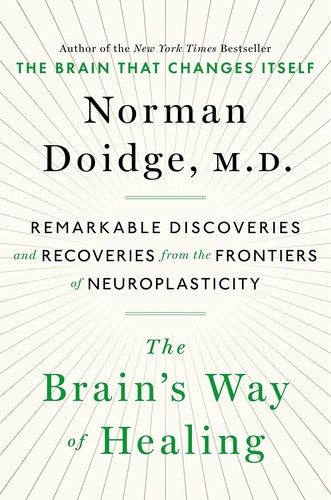
The Brain's Way of Healing by Norman Doidge is a 2015 science book about neuroplasticity, healing, chronic pain. Neuroplasticity — the brain's capacity to reorganize in response to experience — extends throughout life, not just childhood, and applies to recovery from illness and injury, not just learning.
Summary
The Brain's Way of Healing is Norman Doidge's follow-up to The Brain That Changes Itself and extends its central argument: the brain retains significant capacity to reorganize itself throughout life, and this plasticity can be deliberately harnessed to treat conditions that conventional medicine has largely written off as permanent. Doidge is a psychiatrist, not a neuroscientist, and writes as a journalist examining clinicians and researchers who have achieved surprising results using movement, light, sound, and thought to drive brain change.
The book opens with a chapter on pain that remains its strongest section. Doidge examines the work of Michael Moskowitz, a pain specialist who, after suffering a water-skiing injury, used his own knowledge of neuroplasticity to retrain his brain's response to chronic pain. The key insight is that chronic pain involves a brain that has learned to generate a pain signal continuously — it is a form of neural habit. If pain is a learned pattern rather than a structural fact, it can in principle be unlearned. Moskowitz taught himself to visualize his brain areas associated with pain shrinking whenever pain spiked, and over months reduced a severe chronic pain condition that conventional treatments had not touched.
Subsequent chapters examine movement-based treatments for Parkinson's disease, light therapy for stroke and brain injury, and sound-based interventions for developmental disorders. Doidge profiles researchers and clinicians who have worked outside the mainstream and achieved results — results that have, in some cases, been replicated and are now closer to accepted practice than they were when the book was written. The tone throughout is enthusiastic, perhaps overly so: Doidge rarely engages seriously with null results or failed replication attempts.
The book's weakness is its selectivity. Every case study is successful. The implicit argument — that neuroplasticity can treat most conditions if you apply it correctly — is never subjected to the kind of stress-testing that would allow a reader to calibrate how broadly applicable these approaches actually are. Read critically and alongside mainstream clinical literature, it is a valuable survey of an emerging field. Read uncritically, it risks giving chronically ill patients unrealistic expectations about what motivated self-treatment can accomplish.
Talk to The Brain's Way of Healing like its author wrote you back.
Get the ideas that fit your life — not generic summaries.
- Chat with the book
- Audiobook-style main ideas
- Adapts to your life and goals
- Helps you take action
Key takeaways
- 1.
Neuroplasticity — the brain's capacity to reorganize in response to experience — extends throughout life, not just childhood, and applies to recovery from illness and injury, not just learning.
- 2.
Chronic pain is often a learned pattern in the brain rather than a direct signal from damaged tissue. The brain can in some cases be retrained to reduce or eliminate it through deliberate mental and physical practice.
- 3.
Movement is one of the most powerful stimuli for brain change. Activities that require novel, complex coordination — not just repetitive exercise — appear to be especially potent.
- 4.
Light and sound therapies, when applied at specific frequencies and timings, have shown results in conditions ranging from stroke rehabilitation to developmental disorders. The mechanisms are not fully understood but the clinical evidence is accumulating.
- 5.
The brain uses competitive processes: brain regions that go unused are colonized by neighboring regions. Recovery often requires making the damaged system compete for use rather than compensating around it.
- 6.
Attention matters as much as activity. Exercises done with focused attention produce more brain change than the same exercises done while distracted — a finding with significant implications for how rehabilitation is structured.
- 7.
Many clinicians achieving results with neuroplasticity-based approaches worked outside mainstream medicine for years before their results attracted interest. The history suggests that the pace of adoption in medicine is far slower than the pace of discovery.
- 8.
The placebo effect is itself a neuroplasticity phenomenon: expectation and belief trigger real neurological changes, which is one reason it is so difficult to separate treatment effects from expectation effects in this field.
Discussion questions
Use these on your own, with a book club, or as chat starters in Superbook. Book club version, ready to copy or print →
- 1.
Doidge argues that chronic pain is often a learned brain pattern rather than a structural problem. Does that framing change how you think about pain you experience, or pain in someone you care for?
- 2.
The book profiles clinicians who worked outside mainstream medicine for years. How do you decide when an outside-the-mainstream treatment is worth trying versus when it's wishful thinking?
- 3.
Doidge's case studies are all successes. What would you need to know about the failures and null results before changing your view of how broadly applicable these approaches are?
- 4.
Movement that requires novel, complex coordination appears especially effective for brain change. What activities in your own life produce that kind of challenge, and what could you add?
- 5.
The placebo effect is described as a real neurological process. Does that make it more or less acceptable to use it deliberately in clinical settings?
- 6.
The brain's use-it-or-lose-it principle means unused circuits are colonized by neighboring ones. Where in your own cognitive or physical life do you see that process operating?
- 7.
Doidge's enthusiasm for neuroplasticity is consistent across both books. Where do you think he draws the line — if anywhere — between legitimate hope and false promise for patients with serious conditions?
- 8.
The attention requirement — that exercises must be done with focused attention to produce maximum brain change — has practical implications. How do you manage attention during the physical practices in your own life?
- 9.
The book's treatment of Parkinson's disease involves movement therapy that changes symptoms without changing the underlying dopamine deficiency. What does that suggest about the relationship between brain structure and function?
- 10.
Several of the therapists profiled essentially developed their approaches through self-experimentation after personal illness. Is that a feature of the field (motivated investigators) or a warning sign (anecdote-driven research)?
- 11.
If the brain can be trained to reduce chronic pain through mental practice, what does that imply about the responsibility of patients in their own treatment — and the limits of that responsibility?
Themes
Frequently asked questions
-
What is The Brain's Way of Healing about?
It examines how neuroplasticity — the brain's capacity to change in response to experience — can be harnessed to treat chronic pain, Parkinson's disease, stroke, brain injury, and other conditions. Doidge profiles clinicians who have developed movement, light, and sound-based therapies outside the mainstream and achieved results that conventional medicine had not.
-
Is The Brain's Way of Healing worth reading?
Yes, with the caveat that it should be read critically. The clinical cases are remarkable and the concept of neuroplasticity-based treatment is scientifically grounded. But Doidge presents only successes, and the book does not engage seriously with failed treatments or replication challenges. It is inspiring rather than rigorous.
-
Do I need to read The Brain That Changes Itself first?
No. The Brain's Way of Healing is self-contained. The first book established the case for neuroplasticity across domains; the second focuses specifically on healing and recovery. Reading the first book enriches the context, but Doidge provides enough background that new readers won't be lost.
-
Who should read The Brain's Way of Healing?
People dealing with chronic pain, neurological conditions, or recovery from brain injury, and the clinicians, family members, and caregivers working alongside them. Also valuable for anyone interested in the science of rehabilitation and the gap between what research shows is possible and what standard clinical practice currently offers.
-
What is the most actionable idea in The Brain's Way of Healing?
The pain retraining approach described in the opening chapter: using focused mental imagery to visualize the brain areas generating pain shrinking, in the moment when pain spikes. Doidge's account of Moskowitz applying this to his own chronic pain condition is the book's most compelling case study and the most directly applicable for readers experiencing chronic pain.
Similar books
The Brain That Changes Itself
Norman Doidge
Phantoms in the Brain: Probing the Mysteries of the Human Mind
V. S. Ramachandran and Sandra Blakeslee
The Body Keeps the Score
Bessel van der Kolk
Behave: The Biology of Humans at Our Best and Worst
Robert M. Sapolsky
