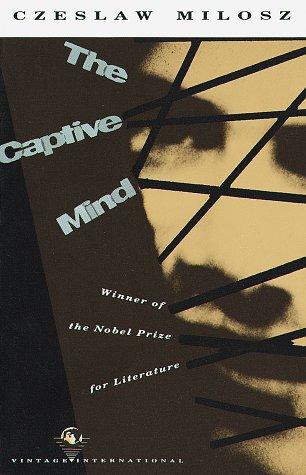
Talk to The Captive Mind like its author wrote you back.
Get the ideas that fit your life — not generic summaries.
- Chat with the book
- Audiobook-style main ideas
- Adapts to your life and goals
- Helps you take action
What it argues
The Captive Mind is Czesław Miłosz's study of how intellectuals living under Soviet-imposed communism in postwar Eastern Europe came to accommodate, justify, and eventually internalize the ideology they had initially resisted. Miłosz wrote it in 1951–52 after defecting from Poland, and it draws on his direct observation of poets, novelists, and thinkers he knew personally who made different choices under the new order. The book is partly autobiography, partly political philosophy, and partly literary criticism.
Miłosz opens with an analysis of what he calls "the pill of Murti-Bing," a literary device from a Polish novel that stands for the feeling of inner peace that comes from surrendering independent thought to a total system. He uses this to explain the appeal of Stalinism to intellectuals who were exhausted by the violence and chaos of World War II: a system that explained everything, assigned everyone a role, and promised a rational future had genuine attractions that pure coercion alone cannot account for.
What it gets right
- 1.
Total ideological systems appeal to intellectuals not only through fear but through the genuine relief of having all questions answered and all uncertainty resolved.
- 2.
Accommodation with power rarely happens in a single decision. It proceeds through a series of small compromises, each of which feels reasonable in context.
- 3.
Ketman — Miłosz's term, borrowed from an Arabic concept — is the technique of maintaining private reservation while performing public belief. It is psychologically costly and eventually corrodes the capacity for independent thought.
What it covers
Who wrote it
Czesław Miłosz (1911–2004) was a Polish-Lithuanian poet, novelist, essayist, and translator. He lived through both Nazi occupation and the early years of communist Poland before defecting to the West in 1951. He spent much of his later career teaching at the University of California, Berkeley. He was awarded the Nobel Prize in Literature in 1980. His other major works include the memoir Native Realm, the poem sequence Bells in Winter, and the philosophical meditation The Land of Ulro. He is considered one of the most significant European writers of the twentieth century.
