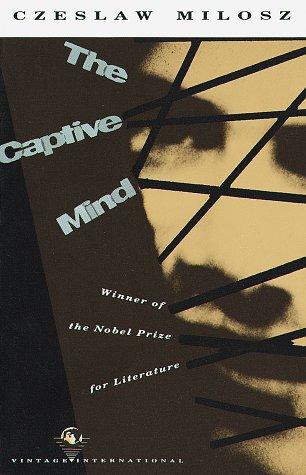
The Captive Mind by Czesław Miłosz is a 1953 history book about totalitarianism, ideology, intellectual compromise. Total ideological systems appeal to intellectuals not only through fear but through the genuine relief of having all questions answered and all uncertainty resolved.
Summary
The Captive Mind is Czesław Miłosz's study of how intellectuals living under Soviet-imposed communism in postwar Eastern Europe came to accommodate, justify, and eventually internalize the ideology they had initially resisted. Miłosz wrote it in 1951–52 after defecting from Poland, and it draws on his direct observation of poets, novelists, and thinkers he knew personally who made different choices under the new order. The book is partly autobiography, partly political philosophy, and partly literary criticism.
Miłosz opens with an analysis of what he calls "the pill of Murti-Bing," a literary device from a Polish novel that stands for the feeling of inner peace that comes from surrendering independent thought to a total system. He uses this to explain the appeal of Stalinism to intellectuals who were exhausted by the violence and chaos of World War II: a system that explained everything, assigned everyone a role, and promised a rational future had genuine attractions that pure coercion alone cannot account for.
The book's most famous section presents four composite portraits — Alpha, Beta, Gamma, Delta — each representing a different intellectual type and a different path toward accommodation with power. None of these figures is simply cowardly or simply corrupt. Each follows a logic that, given the pressures and incentives in place, is comprehensible from the inside. Miłosz is not writing a morality tale; he is writing an anatomy of how intelligent, talented people reason themselves into complicity.
The Captive Mind remains one of the most psychologically precise accounts of what happens to the mind under ideological pressure. Its core insight — that the most dangerous intellectual compromises are those that feel like realism, prudence, or even moral growth — is not limited to communism. Miłosz wrote it about a specific time and place, but it has been read as a manual for recognizing a broader pattern wherever it appears.
Talk to The Captive Mind like its author wrote you back.
Get the ideas that fit your life — not generic summaries.
- Chat with the book
- Audiobook-style main ideas
- Adapts to your life and goals
- Helps you take action
Key takeaways
- 1.
Total ideological systems appeal to intellectuals not only through fear but through the genuine relief of having all questions answered and all uncertainty resolved.
- 2.
Accommodation with power rarely happens in a single decision. It proceeds through a series of small compromises, each of which feels reasonable in context.
- 3.
Ketman — Miłosz's term, borrowed from an Arabic concept — is the technique of maintaining private reservation while performing public belief. It is psychologically costly and eventually corrodes the capacity for independent thought.
- 4.
The most dangerous form of intellectual capitulation is the kind that presents itself as mature realism, strategic patience, or working from within the system.
- 5.
Artists and writers under totalitarian systems face a specific pressure: their tools — language, narrative, character — are also the regime's tools. To write is already to participate in the ideological system.
- 6.
The four intellectual types Miłosz describes — Alpha, Beta, Gamma, Delta — each follow a coherent internal logic. Understanding that logic is more useful than condemning the outcome.
- 7.
Escape from a captive mind is not primarily a political act but an epistemological one: relearning to tolerate uncertainty, ambiguity, and the absence of total explanations.
- 8.
The experience of living under two totalitarianisms — first Nazi occupation, then Soviet imposition — gave Eastern Europeans a particular insight into ideological systems that Western intellectuals, who had lived through neither, often lacked.
Discussion questions
Use these on your own, with a book club, or as chat starters in Superbook. Book club version, ready to copy or print →
- 1.
Miłosz describes the appeal of a total system that explains everything and assigns everyone a role. Have you encountered a secular or political equivalent of this appeal in your own environment?
- 2.
The concept of Ketman describes the practice of public performance and private reservation. Is this always a form of corruption, or are there circumstances in which it is a legitimate survival strategy?
- 3.
Miłosz's four portraits show talented people reasoning themselves into collaboration. Which of the four paths toward accommodation do you find most psychologically recognizable?
- 4.
Miłosz argues that accommodation is rarely a single act of cowardice but a sequence of reasonable-seeming small steps. Can you identify a domain in your own experience — workplace, institution, community — where this dynamic operates?
- 5.
The book was written in the early 1950s about Eastern Europe under Stalinism. Which of its observations do you think are specific to that context, and which describe something more general about ideology and the intellectual?
- 6.
Miłosz suggests that the pill of Murti-Bing — the peace that comes from surrendering independent thought — has genuine attractions. What does this say about human psychology and the burden of intellectual freedom?
- 7.
How should we evaluate writers and artists who produced work under totalitarian conditions, some of which served the regime? Does the quality of the work change the moral assessment?
- 8.
Miłosz was himself a diplomat and cultural official for the new Polish government before he defected. Does his insider knowledge make The Captive Mind more or less credible? Does his own prior accommodation matter for how we read his analysis?
- 9.
The book describes a situation in which telling the truth publicly is impossible. What forms of truth-telling remain available when direct speech is foreclosed?
- 10.
Western intellectuals in the 1950s were often skeptical of anti-communist accounts from Eastern Europe. Miłosz addresses this skepticism. How do we calibrate our response to accounts of ideological oppression that come from those who left?
- 11.
Miłosz argues that Eastern Europeans had an insight into totalitarianism that Westerners lacked. Is this kind of experiential knowledge transferable through reading and study, or does it require having lived under the conditions?
- 12.
The Captive Mind was written over seventy years ago. Which of its arguments feel most alive to contemporary politics, and which feel most dated?
Themes
Frequently asked questions
-
What is the main idea of The Captive Mind?
That intellectuals living under totalitarian systems accommodate ideology not primarily through fear but through a process of reasoning that makes each step toward compliance feel rational or inevitable. Miłosz analyzes this process with psychological precision.
-
Is The Captive Mind still relevant today?
Yes. Its analysis of how intelligent people reason themselves into ideological compliance, how total systems appeal through the relief of certainty, and how Ketman corrodes the capacity for honest thought applies well beyond postwar Eastern Europe.
-
Is The Captive Mind difficult to read?
It is demanding but not technical. The first chapter, on the Murti-Bing pill, requires some patience. The four portraits are vivid and readable. Readers unfamiliar with postwar Polish intellectual life will benefit from a brief background on the period.
-
What is Ketman?
Miłosz borrows the term from the Arabic practice of dissimulating religious belief to avoid persecution. In The Captive Mind he uses it to describe the technique of maintaining private doubt while performing public orthodoxy — a technique that, over time, corrupts the distinction between the two.
-
Who should read The Captive Mind?
Anyone interested in the psychology of ideological conformity, the relationship between intellectuals and power, or the history of communism in Eastern Europe. It is also essential reading for anyone who wants to understand how living under totalitarianism shaped the political thought of figures like Václav Havel, Hannah Arendt, and the authors of 1989.