Talk to The Cathedral and the Bazaar like its author wrote you back.
Get the ideas that fit your life — not generic summaries.
- Chat with the book
- Audiobook-style main ideas
- Adapts to your life and goals
- Helps you take action
The Cathedral and the Bazaar, in detail
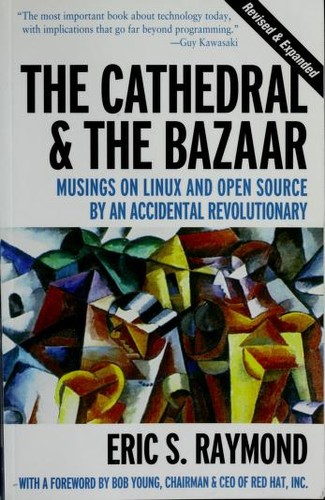
Eric S. Raymond's The Cathedral and the Bazaar is a collection of essays that shaped how the technology industry understood open source software at the end of the twentieth century. The title essay, originally a conference presentation in 1997, uses two metaphors to contrast software development styles: the cathedral, in which a small team of skilled developers works in private until releasing a polished product, and the bazaar, in which development happens publicly and chaotically with contributions from whoever shows up. Raymond argues that Linus Torvalds's development of Linux proved the bazaar model could produce excellent software — not despite its chaos but because of it.
Raymond's central empirical claim is what he calls Linus's Law: "Given enough eyeballs, all bugs are shallow." With enough users and contributors reviewing code, any problem that can be found will be found quickly. This became one of the foundational arguments for open source quality, countering the intuition that software made by paid professionals in private would necessarily be more reliable. The essay documents Raymond's own experiment with the fetchmail project, using his own code release as a case study in applying bazaar principles.
The other essays in the collection extend and complicate the argument. Raymond examines the economic incentives that lead skilled programmers to contribute code without direct payment — reputation, reciprocity, community belonging, and the intrinsic pleasure of good work. He draws on anthropology and game theory to explain gift-giving cultures in technical communities. He also explores the limits of the bazaar model: it works well for code that many people use and can test, less well for niche or highly specialized systems.
Raymond is a polemicist as much as an analyst, and some of the essays age unevenly. The hacker culture he celebrates was already being institutionalized by 1999, and the technology industry's subsequent relationship with open source — adoption, commercialization, and co-optation by large companies — complicates his optimism. But the core insight, that distributed peer production could outperform centralized expert production in specific domains, anticipated Wikipedia, GitHub, and much of what followed.
The big ideas
- 1.
The cathedral model of software development — closed, controlled, released polished — contrasts with the bazaar model — open, distributed, released often. Linux demonstrated that the bazaar could produce world-class software.
- 2.
Linus's Law: given enough eyeballs, all bugs are shallow. Broad public review accelerates finding and fixing problems in ways that a small closed team cannot match.
- 3.
Release early, release often — and listen to users. Iterating quickly with real feedback from actual users produces better software than extended private development cycles.
