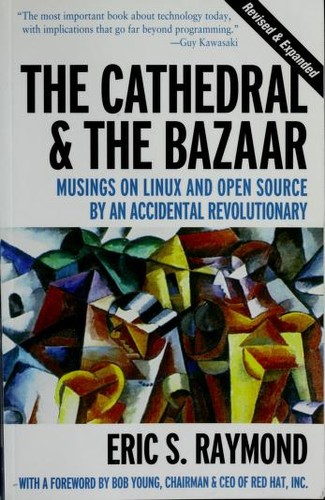
The Cathedral and the Bazaar by Eric S. Raymond is a 1999 science book about open source software, software development, community. The cathedral model of software development — closed, controlled, released polished — contrasts with the bazaar model — open, distributed, released often. Linux demonstrated that the bazaar could produce world-class software.
Summary
Eric S. Raymond's The Cathedral and the Bazaar is a collection of essays that shaped how the technology industry understood open source software at the end of the twentieth century. The title essay, originally a conference presentation in 1997, uses two metaphors to contrast software development styles: the cathedral, in which a small team of skilled developers works in private until releasing a polished product, and the bazaar, in which development happens publicly and chaotically with contributions from whoever shows up. Raymond argues that Linus Torvalds's development of Linux proved the bazaar model could produce excellent software — not despite its chaos but because of it.
Raymond's central empirical claim is what he calls Linus's Law: "Given enough eyeballs, all bugs are shallow." With enough users and contributors reviewing code, any problem that can be found will be found quickly. This became one of the foundational arguments for open source quality, countering the intuition that software made by paid professionals in private would necessarily be more reliable. The essay documents Raymond's own experiment with the fetchmail project, using his own code release as a case study in applying bazaar principles.
The other essays in the collection extend and complicate the argument. Raymond examines the economic incentives that lead skilled programmers to contribute code without direct payment — reputation, reciprocity, community belonging, and the intrinsic pleasure of good work. He draws on anthropology and game theory to explain gift-giving cultures in technical communities. He also explores the limits of the bazaar model: it works well for code that many people use and can test, less well for niche or highly specialized systems.
Raymond is a polemicist as much as an analyst, and some of the essays age unevenly. The hacker culture he celebrates was already being institutionalized by 1999, and the technology industry's subsequent relationship with open source — adoption, commercialization, and co-optation by large companies — complicates his optimism. But the core insight, that distributed peer production could outperform centralized expert production in specific domains, anticipated Wikipedia, GitHub, and much of what followed.
Talk to The Cathedral and the Bazaar like its author wrote you back.
Get the ideas that fit your life — not generic summaries.
- Chat with the book
- Audiobook-style main ideas
- Adapts to your life and goals
- Helps you take action
Key takeaways
- 1.
The cathedral model of software development — closed, controlled, released polished — contrasts with the bazaar model — open, distributed, released often. Linux demonstrated that the bazaar could produce world-class software.
- 2.
Linus's Law: given enough eyeballs, all bugs are shallow. Broad public review accelerates finding and fixing problems in ways that a small closed team cannot match.
- 3.
Release early, release often — and listen to users. Iterating quickly with real feedback from actual users produces better software than extended private development cycles.
- 4.
Open source developers are not primarily motivated by payment. Reputation, reciprocity, technical pleasure, and community belonging explain voluntary high-quality contribution to shared projects.
- 5.
The gift economy of hacker culture follows rules analogous to tribal gift-giving: status accrues to those who give, and contribution is a social act as much as a technical one.
- 6.
The bazaar model is not universally superior. It works best where there is a large, capable user base who can test and identify bugs. Niche or safety-critical software may not benefit equally.
- 7.
Good software design requires recognizing when someone else has solved your problem. One of the most important skills in open source development is finding and adapting existing solutions rather than reinventing them.
- 8.
Raymond's essays shaped the open source movement's self-understanding and were influential in convincing corporations like Netscape to open-source code — a direct industrial consequence of an essay.
Discussion questions
Use these on your own, with a book club, or as chat starters in Superbook. Book club version, ready to copy or print →
- 1.
Raymond contrasts cathedral and bazaar models of development. Where else do you see these two modes of production competing — in fields outside software?
- 2.
Linus's Law assumes many eyeballs are reviewing code. In practice, most open source projects have very few active contributors. Does this undermine the argument or just change its scope?
- 3.
Raymond argues that distributed open development can outperform closed expert development. How does this claim hold up given the security vulnerabilities that have appeared in widely used open source libraries?
- 4.
The essays explain open source contribution through reputation and reciprocity. How much of your own professional or creative work is driven by those same incentives?
- 5.
Raymond writes about hacker culture as a gift economy. Does that description still apply to the open source ecosystem twenty-five years later, or has commercial adoption changed its character?
- 6.
The book was written before GitHub, Stack Overflow, or modern open source infrastructure existed. What does the current open source ecosystem confirm and what does it complicate in Raymond's argument?
- 7.
Raymond was also controversial for cultural views outside software. How do you read technical arguments from an author whose broader values you might not share?
- 8.
Release early, release often is good advice for some software. Where does that principle break down, and what does that tell you about the limits of the bazaar model?
- 9.
Large companies now employ the majority of contributors to major open source projects. Has open source been co-opted, captured, or successfully scaled — and how do you tell the difference?
- 10.
What is the equivalent of open source collaboration in your own field? Where could distributed peer production outperform centralized expert production, and where would it fail?
- 11.
Raymond uses his own fetchmail project as evidence for his thesis. Does a self-reported case study like this carry weight for you, or do you require independent evidence?
- 12.
The title essay was written in 1997 and the book published in 1999. Which of Raymond's predictions turned out most accurate, and which did not?
Themes
Frequently asked questions
-
What is The Cathedral and the Bazaar about?
It argues that open, distributed software development — the bazaar — can produce better software than the closed, expert-team model — the cathedral. Raymond uses Linux and his own fetchmail project as evidence, and extends the argument to explain the economic incentives behind voluntary open source contribution.
-
Is this book relevant in 2026?
Yes. The open source model it advocated is now the dominant mode of infrastructure software development. But the corporate capture of major open source projects, the security problems revealed in widely used libraries, and the AI-generated code revolution raise new questions that Raymond's essays do not address.
-
Do I need to be a programmer to read it?
No. The essays are written for a technically interested general audience. You do not need to understand the specific code examples to follow the arguments about development models, incentives, and community dynamics.
-
How long does it take to read?
Around four to five hours. The book is a collection of essays of varying length, and the title essay is the most essential. Reading the first three essays gives you the core argument; the remaining essays extend and complicate it.
-
What is Linus's Law?
Raymond's shorthand for the claim that given enough eyeballs — users and developers reviewing code publicly — any bug can be found and fixed. It is the key empirical claim behind the argument that open source code can match or exceed the quality of closed commercial software.
Similar books
Hackers: Heroes of the Computer Revolution
Steven Levy
Code: The Hidden Language of Computer Hardware and Software
Charles Petzold
Zero to One: Notes on Startups, or How to Build the Future
Peter Thiel
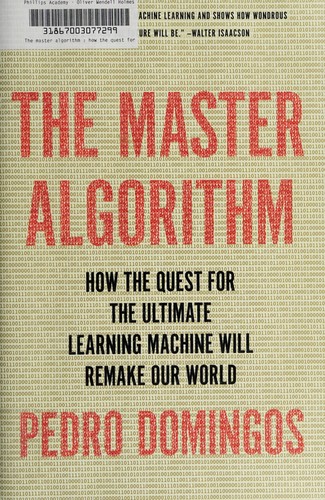
The Master Algorithm
Pedro Domingos
