Talk to The CEO Next Door like its author wrote you back.
Get the ideas that fit your life — not generic summaries.
- Chat with the book
- Audiobook-style main ideas
- Adapts to your life and goals
- Helps you take action
What it argues
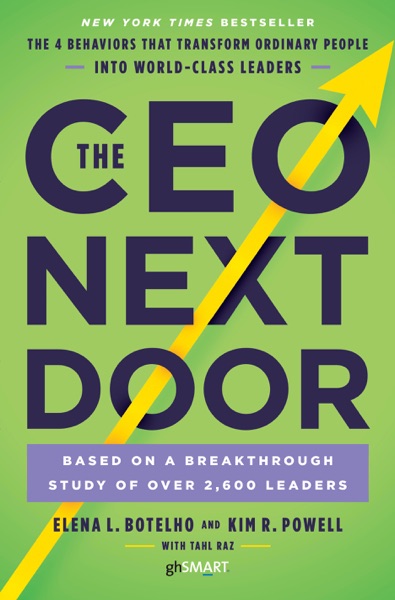
The CEO Next Door is Elena Botelho and Kim Powell's data-driven portrait of what separates successful CEOs from unsuccessful ones. Botelho and Powell are partners at the executive search and leadership advisory firm ghSMART, which maintains a database of assessments called CEO Genome — a ten-year study of 17,000 executives that forms the empirical backbone of the book. The finding that drives everything else: real CEOs don't match the superhero archetype that dominates boardroom mythology.
Botelho and Powell identify four behaviors that differentiate high-performing CEOs from their peers. First, deciding with speed and conviction — not necessarily with complete information, but with clear judgment and visible commitment that allows the organization to move. Second, engaging for impact — not charm or presence, but the disciplined ability to align stakeholders, manage up, and translate strategy into action across the organization. Third, relentless reliability — delivering on commitments consistently, which builds the trust that lets executives take bigger bets. Fourth, adapting boldly — updating mental models quickly when conditions change rather than defending previous positions.
What it gets right
- 1.
Successful CEOs don't fit the superhero archetype. Data from 17,000 executives shows the profile is more mundane and more learnable than popular mythology suggests.
- 2.
Deciding with speed and conviction matters more than deciding with perfect information. Slow, hedged decisions create organizational paralysis.
- 3.
Engaging for impact means translating strategy into aligned stakeholder action — not charisma or presence. Many effective CEOs are introverted.
What it covers
Who wrote it
Elena Botelho and Kim Powell are partners at ghSMART, an executive advisory firm that has assessed thousands of leaders over several decades. Their CEO Genome research project, covering more than 17,000 executives, forms the empirical foundation of The CEO Next Door. Botelho specializes in CEO and board effectiveness and has advised companies across technology, private equity, and Fortune 500 contexts. Powell focuses on executive development and career acceleration. Both bring a research-practitioner background that distinguishes the book from leadership titles based primarily on anecdote or single-company observation.
