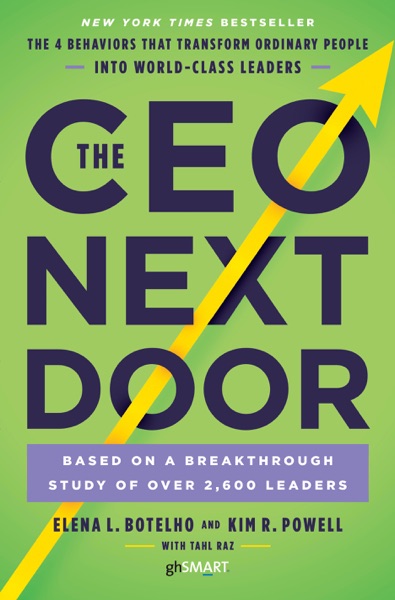
The CEO Next Door by Elena Botelho and Kim Powell is a 2018 business book about leadership, career development, executive effectiveness. Successful CEOs don't fit the superhero archetype. Data from 17,000 executives shows the profile is more mundane and more learnable than popular mythology suggests.
Summary
The CEO Next Door is Elena Botelho and Kim Powell's data-driven portrait of what separates successful CEOs from unsuccessful ones. Botelho and Powell are partners at the executive search and leadership advisory firm ghSMART, which maintains a database of assessments called CEO Genome — a ten-year study of 17,000 executives that forms the empirical backbone of the book. The finding that drives everything else: real CEOs don't match the superhero archetype that dominates boardroom mythology.
Botelho and Powell identify four behaviors that differentiate high-performing CEOs from their peers. First, deciding with speed and conviction — not necessarily with complete information, but with clear judgment and visible commitment that allows the organization to move. Second, engaging for impact — not charm or presence, but the disciplined ability to align stakeholders, manage up, and translate strategy into action across the organization. Third, relentless reliability — delivering on commitments consistently, which builds the trust that lets executives take bigger bets. Fourth, adapting boldly — updating mental models quickly when conditions change rather than defending previous positions.
The book also dismantles several myths about what CEOs need to succeed. Elite education has no statistical correlation with CEO effectiveness. Charisma is present in only a minority of successful CEOs. Introversion is at least as common as extroversion at the top. The profile that emerges is less extraordinary genius and more disciplined execution of a learnable set of behaviors.
Perhaps most interesting is the book's treatment of CEO career paths. The data shows that most successful CEOs had setbacks — significant failures or derailments at earlier career stages — that they turned into credibility rather than hiding. The authors call this the "catapult" and argue it is one of the strongest predictors of eventual leadership success. The book is most useful for executives and aspiring leaders, but its specific patterns make it readable for anyone interested in how leadership capability actually develops rather than how it is mythologized.
Talk to The CEO Next Door like its author wrote you back.
Get the ideas that fit your life — not generic summaries.
- Chat with the book
- Audiobook-style main ideas
- Adapts to your life and goals
- Helps you take action
Key takeaways
- 1.
Successful CEOs don't fit the superhero archetype. Data from 17,000 executives shows the profile is more mundane and more learnable than popular mythology suggests.
- 2.
Deciding with speed and conviction matters more than deciding with perfect information. Slow, hedged decisions create organizational paralysis.
- 3.
Engaging for impact means translating strategy into aligned stakeholder action — not charisma or presence. Many effective CEOs are introverted.
- 4.
Relentless reliability — consistently delivering on commitments — is the primary trust-building mechanism. Trust is what earns executives the license to take bigger risks.
- 5.
Adapting boldly requires updating mental models faster than the organization expects. The leaders who fail often do so by defending their previous successful strategies too long.
- 6.
Elite education, pedigree, and charisma have no statistical correlation with CEO effectiveness. They predict selection, not performance.
- 7.
Career setbacks and failures, when processed well, are among the strongest predictors of eventual leadership success. The catapult story matters more than the clean resume.
- 8.
Most executives are not held back by a lack of skills but by a lack of self-awareness about one or two specific behaviors that consistently undermine them in high-stakes moments.
Discussion questions
Use these on your own, with a book club, or as chat starters in Superbook. Book club version, ready to copy or print →
- 1.
Botelho and Powell say the most successful CEOs decide with speed and conviction rather than with complete information. Is there a decision you're currently delaying that would benefit from a faster call?
- 2.
The book argues charisma is overrated and reliability underrated. Think of the most effective leader you've worked with closely. Which mattered more in practice?
- 3.
The 'catapult' pattern shows that setbacks and failures, processed well, predict leadership success. What has been your most significant professional failure, and what did you do with it?
- 4.
Engaging for impact is about alignment and execution, not presence. Where in your current work are you relying on presence or relationship when you need to focus on alignment?
- 5.
The data shows elite credentials don't predict CEO performance. Does that match your experience of who actually leads well in organizations you know?
- 6.
Adapting boldly means updating your mental model when conditions change. Is there something you currently believe about your market, your team, or your strategy that you haven't seriously questioned recently?
- 7.
Reliability builds trust. Think of the last commitment you made that you didn't keep. What was the trust cost of that, and how did you rebuild it?
- 8.
The book profiles many CEOs who succeeded despite introversion, unconventional backgrounds, or significant gaps in their resume. What assumptions about who can be an effective executive does that challenge for you?
- 9.
If someone assessed your career on the four CEO behaviors — speed and conviction, engaging for impact, reliability, and bold adaptation — which would be your weakest? What's one specific situation where that weakness has cost you?
- 10.
The authors say most executives are held back by one or two specific behaviors that undermine them under pressure. What would your board, your peers, or your direct reports say yours are?
- 11.
How do organizations accidentally select for the wrong qualities in their CEO and leadership succession processes? What would a better selection process look like?
- 12.
The book is based on large-scale data. What do you think a data set of 17,000 executive assessments might systematically miss about what makes someone an effective leader?
Themes
Frequently asked questions
-
What is The CEO Next Door about?
It's a data-driven study of what actually predicts CEO success, based on assessment data from 17,000 executives. The main finding is that the effective CEO profile is more ordinary and learnable than the charismatic genius archetype suggests, and four specific behaviors account for most of the variance.
-
Is The CEO Next Door only relevant if you want to become a CEO?
No. The four behaviors — decisive speed, impact-oriented engagement, reliability, and bold adaptation — apply to any leadership role. The sections on setbacks as career accelerators and on self-awareness are particularly useful for mid-level leaders managing their careers.
-
What is the 'catapult' in The CEO Next Door?
The pattern where a significant career setback — a fired job, a failed initiative, a public mistake — becomes a credential rather than a liability. The research shows that leaders who process failure well and are transparent about it tend to outperform those with clean records, partly because they've developed judgment that only comes from navigating real difficulty.
-
How does this book compare to Good to Great?
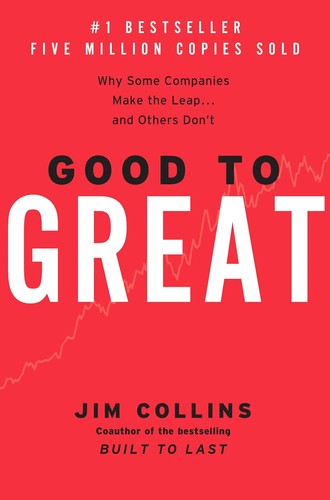
Both are research-based leadership books. Good to Great focuses on company-level characteristics; The CEO Next Door focuses on individual leader behaviors. Good to Great's sample is smaller and its methods more interpretive; The CEO Next Door's database is larger and more focused on behavioral patterns. They complement each other.
-
What's the most important behavior for CEO success according to the research?
Relentless reliability — consistently delivering on commitments, large and small. The research shows it is the primary driver of the trust that allows executives to eventually take bigger risks and make bigger calls. Without it, the other behaviors don't accumulate into leadership credibility.