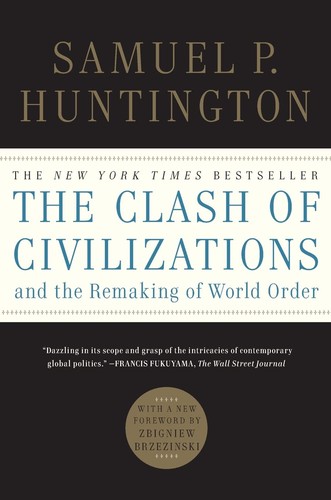
Talk to The Clash of Civilizations and the Remaking of World Order like its author wrote you back.
Get the ideas that fit your life — not generic summaries.
- Chat with the book
- Audiobook-style main ideas
- Adapts to your life and goals
- Helps you take action
The Clash of Civilizations and the Remaking of World Order, in detail
Samuel Huntington's The Clash of Civilizations and the Remaking of World Order, published in 1996, is an expansion of a 1993 Foreign Affairs essay that generated more response than almost any article in that journal's history. Huntington's core argument is that after the Cold War, the primary conflicts in world politics would no longer be ideological or economic but cultural — that the fault lines between civilizations would be the main battleground of the late twentieth and twenty-first centuries.
Huntington identifies seven or eight major civilizations: Western, Confucian (Chinese), Japanese, Islamic, Hindu, Slavic-Orthodox, Latin American, and possibly African. He argues that these are not simply geographic groupings but coherent cultural identities defined by language, religion, history, and shared values. In the post-Cold War world, he contends, people define themselves primarily by these civilizational identities rather than by nation, ideology, or class. The major conflicts of the future would occur along civilizational fault lines — particularly between the West and Islam, and between the West and China.
The book's argument was controversial at publication and became dramatically more contentious after September 11, 2001, when many commentators argued it had been vindicated. Critics pointed out that Huntington treated civilizations as monolithic when they contain enormous internal diversity, that he underestimated economic interdependence, and that his framework could function as a self-fulfilling prophecy — treating conflict as inevitable encourages the policies that produce it. Defenders argued that events since 1993 have confirmed his basic pattern, if not every detail.
Whatever its empirical weaknesses, the book shaped how a generation of policymakers and analysts thought about international order. Its central question — whether cultural and religious identity is a more powerful driver of conflict than economic interest — has not gone away. The debate it opened remains live, and reading it carefully means understanding both what Huntington got right about identity politics and what his framework systematically obscures.
The big ideas
- 1.
The primary source of conflict in the post-Cold War world is not ideological or economic but cultural — identity defined by civilization, language, history, and religion.
- 2.
Huntington identifies seven or eight major civilizations as the principal units of global political analysis, arguing these have more explanatory power than nation-states for predicting conflicts.
- 3.
The most dangerous fault lines run between Western Christianity, Islam, and China — not because conflict is inevitable but because these civilizations have the most incompatible core values and the most direct strategic competition.
