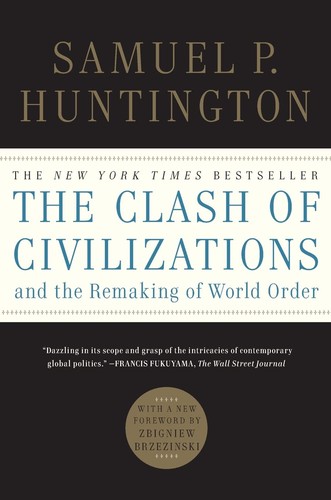
The Clash of Civilizations and the Remaking of World Order by Samuel P. Huntington is a 1996 history book about geopolitics, cultural identity, international relations. The primary source of conflict in the post-Cold War world is not ideological or economic but cultural — identity defined by civilization, language, history, and religion.
Summary
Samuel Huntington's The Clash of Civilizations and the Remaking of World Order, published in 1996, is an expansion of a 1993 Foreign Affairs essay that generated more response than almost any article in that journal's history. Huntington's core argument is that after the Cold War, the primary conflicts in world politics would no longer be ideological or economic but cultural — that the fault lines between civilizations would be the main battleground of the late twentieth and twenty-first centuries.
Huntington identifies seven or eight major civilizations: Western, Confucian (Chinese), Japanese, Islamic, Hindu, Slavic-Orthodox, Latin American, and possibly African. He argues that these are not simply geographic groupings but coherent cultural identities defined by language, religion, history, and shared values. In the post-Cold War world, he contends, people define themselves primarily by these civilizational identities rather than by nation, ideology, or class. The major conflicts of the future would occur along civilizational fault lines — particularly between the West and Islam, and between the West and China.
The book's argument was controversial at publication and became dramatically more contentious after September 11, 2001, when many commentators argued it had been vindicated. Critics pointed out that Huntington treated civilizations as monolithic when they contain enormous internal diversity, that he underestimated economic interdependence, and that his framework could function as a self-fulfilling prophecy — treating conflict as inevitable encourages the policies that produce it. Defenders argued that events since 1993 have confirmed his basic pattern, if not every detail.
Whatever its empirical weaknesses, the book shaped how a generation of policymakers and analysts thought about international order. Its central question — whether cultural and religious identity is a more powerful driver of conflict than economic interest — has not gone away. The debate it opened remains live, and reading it carefully means understanding both what Huntington got right about identity politics and what his framework systematically obscures.
Talk to The Clash of Civilizations and the Remaking of World Order like its author wrote you back.
Get the ideas that fit your life — not generic summaries.
- Chat with the book
- Audiobook-style main ideas
- Adapts to your life and goals
- Helps you take action
Key takeaways
- 1.
The primary source of conflict in the post-Cold War world is not ideological or economic but cultural — identity defined by civilization, language, history, and religion.
- 2.
Huntington identifies seven or eight major civilizations as the principal units of global political analysis, arguing these have more explanatory power than nation-states for predicting conflicts.
- 3.
The most dangerous fault lines run between Western Christianity, Islam, and China — not because conflict is inevitable but because these civilizations have the most incompatible core values and the most direct strategic competition.
- 4.
The West's decline relative to non-Western civilizations — particularly China and Islam — is a structural reality that Western universalism and promotion of democracy cannot reverse.
- 5.
Western values are not universal values. Huntington argues that treating them as such is a form of cultural imperialism that generates resentment and resistance rather than convergence.
- 6.
Modernization and Westernization are not the same thing. Countries can develop economically and technologically while becoming more, not less, culturally assertive and anti-Western.
- 7.
The most stable international order would involve the West acknowledging its declining relative power and negotiating with other civilizations rather than attempting to impose its own model.
- 8.
Civilizations are not monolithic but they do have cores — dominant states that provide cultural and political leadership. Conflict between core states of rival civilizations is the most dangerous kind.
Discussion questions
Use these on your own, with a book club, or as chat starters in Superbook. Book club version, ready to copy or print →
- 1.
Huntington claims cultural identity is a more fundamental driver of conflict than economic interest. Which recent conflicts or alliances do you think best test that claim?
- 2.
Critics argue his civilizational categories are too broad and internally diverse to be analytically useful. Where do you think the boundaries between civilizations actually run, and does the concept survive that criticism?
- 3.
His claim that Western values are not universal was controversial in 1996 and remains so. How do you think about the relationship between Western liberal values and genuine universalism?
- 4.
The book was widely cited after 9/11 as vindicated. Does the 'War on Terror' and its aftermath support or undermine Huntington's framework?
- 5.
Huntington argues modernization does not lead to Westernization. What examples of countries becoming more economically developed while becoming more culturally assertive come to mind?
- 6.
The book's prescription — that the West should accept its declining power and negotiate rather than dominate — was not followed. What do you think the consequences of that choice have been?
- 7.
How does Huntington's civilizational framework compare to the liberal internationalist view that economic interdependence and institutions create stable peace?
- 8.
The framework treats civilizations partly as defined by religion. How does that assumption hold up in increasingly secular societies, and in societies where religious identity is intensifying?
- 9.
Which of Huntington's predictions from 1996 have been most clearly confirmed, and which have been most clearly falsified by subsequent events?
- 10.
Critics argue the book can function as a self-fulfilling prophecy — if powerful people believe civilizational conflict is inevitable, their policies help produce it. How do you evaluate that critique?
- 11.
How does Huntington's framework apply to the rise of China since 1996? Did he correctly anticipate the nature of US-China competition?
- 12.
What would have to be true for Huntington to be fundamentally wrong about the future of international order? What alternative frameworks do you find more compelling?
Themes
Frequently asked questions
-
Was Huntington right about the clash of civilizations?
Partially. His identification of Islamic-Western and US-China tensions as central has held up. His treatment of civilizations as monolithic blocs has not — internal diversity within each civilization often matters more than civilizational solidarity. Most analysts use his framework selectively rather than wholesale.
-
How long is The Clash of Civilizations?
The main text runs about 360 pages. At average reading pace it takes 10 to 12 hours. The argument is developed systematically, so skipping chapters risks missing the analytical structure.
-
What is the main idea of The Clash of Civilizations?
That cultural identity — defined by civilization, religion, language, and history — is displacing ideology and economics as the primary driver of conflict in the post-Cold War world, and that future major conflicts will occur along civilizational fault lines.
-
Who should read The Clash of Civilizations?
Anyone interested in international relations, geopolitics, or the role of religion and culture in political conflict. It is essential background for understanding debates about US foreign policy, the War on Terror, and US-China competition, even — especially — for readers who ultimately disagree with it.
-
What are the main criticisms of Huntington's theory?
That his civilizational categories are too internally diverse to be useful, that he underestimates economic interdependence, that he naturalizes conflict by treating it as inevitable, and that the framework implicitly privileges a Western perspective even while arguing against Western universalism.