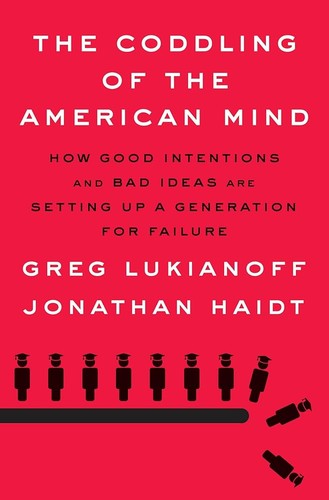
Talk to The Coddling of the American Mind like its author wrote you back.
Get the ideas that fit your life — not generic summaries.
- Chat with the book
- Audiobook-style main ideas
- Adapts to your life and goals
- Helps you take action
What it argues
Greg Lukianoff and Jonathan Haidt argue that American universities — and the parents and institutions that feed them — have adopted three ideas they call the Great Untruths: that what doesn't kill you makes you weaker, that you should always trust your feelings, and that life is a battle between good people and evil people. These ideas feel compassionate. Lukianoff and Haidt say they are, in fact, antithetical to what psychology has learned about resilience, emotional reasoning, and moral development.
The cognitive behavioral therapy framing is central to the book's thesis. Lukianoff, who credits CBT with helping him recover from depression, recognized a familiar pattern in the emotional reasoning and catastrophizing he saw spreading on campuses in the 2010s. What CBT treats as distortions to be corrected — mind reading, labeling, magnification — were being treated by campus culture as moral insights to be protected. The result, the authors argue, is students who are less equipped to handle disagreement, setback, or discomfort, not because they are weak but because the system around them has been optimized to prevent exposure to adversity.
What it gets right
- 1.
The three Great Untruths — fragility, emotional reasoning, and us-versus-them thinking — feel protective but actively undermine resilience and honest thinking.
- 2.
Cognitive behavioral therapy identifies the same distortions (catastrophizing, mind-reading, labeling) that campus culture began treating as legitimate moral perception rather than errors to correct.
- 3.
Antifragile systems need stressors to grow stronger. Children and young adults who are shielded from all adversity become more fragile, not safer.
What it covers
Who wrote it
Greg Lukianoff is a First Amendment attorney and president of the Foundation for Individual Rights and Expression (FIRE). He has written extensively on free speech and campus culture, including Unlearning Liberty. Jonathan Haidt is a social psychologist at New York University's Stern School of Business and the author of The Happiness Hypothesis and The Righteous Mind. His work on moral psychology and political polarization has made him one of the most cited social scientists writing for a general audience. The two authors first collaborated on a 2015 Atlantic article that became the seed of this book.
