The Coddling of the American Mind by Greg Lukianoff and Jonathan Haidt is a 2018 psychology book about overprotection, cognitive distortions, free speech. The three Great Untruths — fragility, emotional reasoning, and us-versus-them thinking — feel protective but actively undermine resilience and honest thinking.
Summary
Greg Lukianoff and Jonathan Haidt argue that American universities — and the parents and institutions that feed them — have adopted three ideas they call the Great Untruths: that what doesn't kill you makes you weaker, that you should always trust your feelings, and that life is a battle between good people and evil people. These ideas feel compassionate. Lukianoff and Haidt say they are, in fact, antithetical to what psychology has learned about resilience, emotional reasoning, and moral development.
The cognitive behavioral therapy framing is central to the book's thesis. Lukianoff, who credits CBT with helping him recover from depression, recognized a familiar pattern in the emotional reasoning and catastrophizing he saw spreading on campuses in the 2010s. What CBT treats as distortions to be corrected — mind reading, labeling, magnification — were being treated by campus culture as moral insights to be protected. The result, the authors argue, is students who are less equipped to handle disagreement, setback, or discomfort, not because they are weak but because the system around them has been optimized to prevent exposure to adversity.
The book traces several contributing causes: the decline of unsupervised childhood play, "helicopter" and "safetyism" parenting, social media and the smartphone transformation of adolescence (especially for girls), growing political polarization that turned campus speech debates into proxy culture war battles, and administrative incentives that reward the avoidance of controversy rather than its productive engagement. The authors are careful to distinguish between physical safety and psychological safety, arguing the former is non-negotiable while the pursuit of the latter at all costs produces fragility.
Lukianoff and Haidt write from different starting points — Lukianoff is a First Amendment lawyer who runs FIRE, Haidt is a social psychologist — and their collaboration gives the book an unusual range. The first half is the more convincing: the psychological case against the three Great Untruths is well-grounded. The second half, diagnosing causes and proposing fixes, is more contested and the policy recommendations are modest given the scale of the problem they describe. The book is most useful as a framework for thinking about adversity, resilience, and the difference between genuine harm and discomfort.
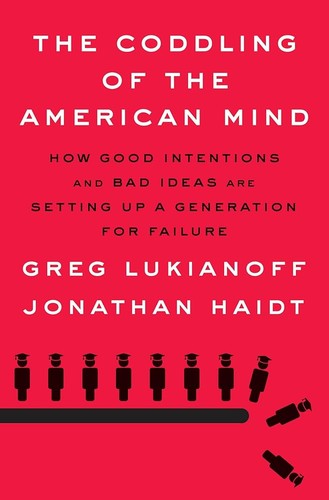
Talk to The Coddling of the American Mind like its author wrote you back.
Get the ideas that fit your life — not generic summaries.
- Chat with the book
- Audiobook-style main ideas
- Adapts to your life and goals
- Helps you take action
Key takeaways
- 1.
The three Great Untruths — fragility, emotional reasoning, and us-versus-them thinking — feel protective but actively undermine resilience and honest thinking.
- 2.
Cognitive behavioral therapy identifies the same distortions (catastrophizing, mind-reading, labeling) that campus culture began treating as legitimate moral perception rather than errors to correct.
- 3.
Antifragile systems need stressors to grow stronger. Children and young adults who are shielded from all adversity become more fragile, not safer.
- 4.
The decline of unsupervised childhood play since the 1980s has reduced children's opportunities to resolve conflict, tolerate frustration, and build independence on their own terms.
- 5.
Smartphones and social media transformed adolescent social life after 2012, with particularly severe consequences for girls, who shifted from in-person social interaction to comparison-heavy online environments.
- 6.
Safetyism — the belief that safety trumps all other values — creates incentives for administrators, parents, and students to treat discomfort as danger, which conflates the two in ways that harm genuine learning.
- 7.
Political polarization on campus transformed debates about speech and harm into tribal loyalty tests, making good-faith engagement across disagreement structurally harder for everyone.
- 8.
The goal is not to expose students to pointless harm but to prepare them for a world that will not protect them from difficulty — a distinction between vindictive and inoculative challenge.
Discussion questions
Use these on your own, with a book club, or as chat starters in Superbook. Book club version, ready to copy or print →
- 1.
Lukianoff and Haidt identify three Great Untruths. Which one do you think is most deeply embedded in institutions you've been part of?
- 2.
The book draws heavily on CBT to argue that emotional reasoning is often unreliable. When in your own life have you mistaken a feeling for a fact?
- 3.
What's the right amount of adversity to expose a child or student to? Where does the line sit between preparation and cruelty?
- 4.
The authors argue unsupervised play is critical for development. How much of it did you have growing up, and what did you learn from it that couldn't have been taught by an adult?
- 5.
Haidt and Lukianoff are critics of certain campus speech norms, but they're also critics of the political right's campus provocateurs. Does the book treat both sides with equal scrutiny, in your reading?
- 6.
The smartphone and social media diagnosis is prominent in the book. How does your own relationship with these platforms affect your mood, attention, and tolerance for disagreement?
- 7.
When does protecting someone from harm cross into preventing them from developing the capacity to handle harm? Is there a concrete example from your own experience?
- 8.
The book argues that administrators often act in ways that increase fragility because it reduces short-term conflict. What other institutions or systems have you seen make the same tradeoff?
- 9.
Lukianoff credits CBT with saving his life. Does the therapeutic framing strengthen the book's argument for you, or does it feel like it overreaches?
- 10.
The authors distinguish between physical safety and psychological safety. Do you think that distinction is as clean in practice as they suggest?
- 11.
What's a belief you hold that you've never had to seriously defend? What would happen if you had to?
- 12.
The book was published in 2018. Which of its predictions or diagnoses have aged well, and which look different now?
Themes
Frequently asked questions
-
What is The Coddling of the American Mind about?
Lukianoff and Haidt argue that three false ideas — that adversity always harms, that feelings are reliable guides to truth, and that people are either all good or all evil — have spread through American universities and are making young people less resilient and less able to engage with disagreement.
-
Is The Coddling of the American Mind worth reading?
Yes, particularly the first half. The psychological grounding in CBT and resilience research is solid, and the antifragility framing is genuinely useful. Readers who disagree with its political implications will still find the developmental psychology sections worth engaging with on their merits.
-
How long does it take to read The Coddling of the American Mind?
Around six to six and a half hours at average reading pace. The book is 352 pages and written for a general audience, so it moves quickly. The argument is front-loaded; the second half with policy recommendations is slower.
-
Who should read this book?
Parents, educators, and anyone working with young people will find the most direct application. It's also useful for anyone trying to understand the campus speech debates of the 2010s or the broader psychology of fragility and resilience.
-
Is the book politically biased?
Lukianoff and Haidt are both liberals who take pains to critique provocateurs on the right as well as overreach on the left. Readers across the spectrum have found it either admirably even-handed or insufficiently critical of one side or the other — which may itself be a sign the book is navigating genuinely contested territory.
-
What is the most actionable idea in the book?
Treat cognitive distortions — catastrophizing, mind reading, labeling — as errors to correct rather than signals to amplify. The same CBT techniques that help individuals recover from anxiety and depression can be taught as intellectual habits, and the book argues institutions can be designed to reinforce rather than undermine them.
Similar books
The Righteous Mind: Why Good People Are Divided by Politics and Religion
Jonathan Haidt
The Anxious Generation
Jonathan Haidt
Thinking, Fast and Slow
Daniel Kahneman

Mindset: The New Psychology of Success
Carol S. Dweck
