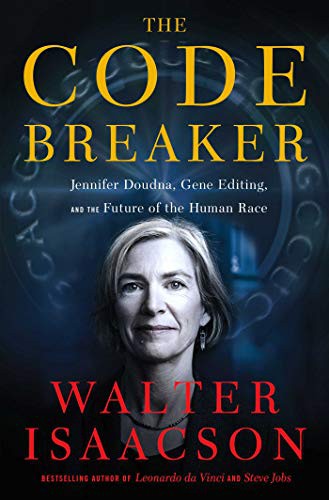
Talk to The Code Breaker: Jennifer Doudna, Gene Editing, and the Future of the Human Race like its author wrote you back.
Get the ideas that fit your life — not generic summaries.
- Chat with the book
- Audiobook-style main ideas
- Adapts to your life and goals
- Helps you take action
The Code Breaker: Jennifer Doudna, Gene Editing, and the Future of the Human Race, in detail
The Code Breaker is Walter Isaacson's account of how CRISPR gene-editing technology was discovered and what it means for the future of medicine and humanity. The book centers on Jennifer Doudna, a Berkeley biochemist who shared the 2020 Nobel Prize in Chemistry for her work developing CRISPR-Cas9 into a precise gene-editing tool. Isaacson uses her career as the spine of a larger story about how science actually works: through competition, collaboration, personal ambition, and occasional disputes over credit.
CRISPR began as a biological curiosity — a defense mechanism used by bacteria to store and recognize the DNA sequences of viruses that had attacked them. Doudna and her collaborators recognized that the same molecular machinery could be repurposed to cut and edit DNA in any organism with surgical precision. The discovery touched off an extraordinary race among laboratories in Berkeley, Cambridge, and Boston, culminating in a bitter patent dispute between Doudna's team and Feng Zhang's lab at the Broad Institute — a dispute that is still playing out in courts.
Isaacson is a skilled popularizer and the molecular biology never becomes impenetrable. The book is at its best tracking the human dynamics: the competitive friendships, the politics of credit, the gender dynamics Doudna navigated in a male-dominated field. It is less rigorous when it comes to the ethics. The final sections on germline editing — permanently heritable changes to the human genome — are thoughtful but somewhat superficial, particularly given the gravity of what is being discussed.
The 2018 case of He Jiankui, the Chinese scientist who created the first CRISPR babies in an experiment widely condemned as reckless, sharpens the ethical questions Isaacson raises throughout. The book ends with a view of CRISPR as a technology that has already changed medicine and will continue to do so at a pace that governance has not kept up with. What gets made of it depends on decisions being made now, mostly by people who haven't fully thought them through.
The big ideas
- 1.
CRISPR-Cas9 is a gene-editing tool derived from a bacterial immune system that allows scientists to cut and rewrite DNA sequences with unprecedented precision.
- 2.
Jennifer Doudna and Emmanuelle Charpentier shared the 2020 Nobel Prize, but the patent dispute with Feng Zhang's team shows how contested scientific credit can be even in collaborative fields.
- 3.
Germline editing — changes to eggs, sperm, or embryos — produces heritable modifications that would affect not just the individual but all their descendants.
