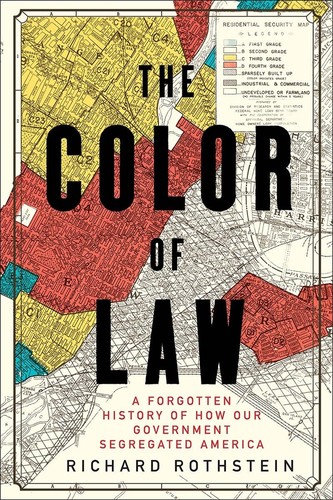
Talk to The Color of Law: A Forgotten History of How Our Government Segregated America like its author wrote you back.
Get the ideas that fit your life — not generic summaries.
- Chat with the book
- Audiobook-style main ideas
- Adapts to your life and goals
- Helps you take action
What it argues
Richard Rothstein's The Color of Law makes a precise and uncomfortable argument: residential segregation in American cities was not the result of private prejudice or individual choice but of explicit, deliberate government policy at the federal, state, and local levels. The distinction matters legally and politically. If segregation is the product of de facto choices — where people chose to live, what they could afford — then there is no clear government obligation to remedy it. If it is the product of de jure action — laws, regulations, and government programs that enforced racial separation — then the argument for remediation is constitutionally grounded.
Rothstein documents the mechanisms in systematic detail. The Federal Housing Administration, established in 1934, refused to insure mortgages in racially mixed neighborhoods, a practice known as redlining. Public housing projects were explicitly segregated by race, not by economic sorting. The GI Bill, which created the white middle-class suburbs of the postwar era, was administered in ways that excluded most Black veterans. Racially restrictive covenants — contractual prohibitions on selling homes to Black buyers — were enforced by courts until 1948 and effectively until much longer through private practice. Cities used zoning laws to confine Black residents to industrial areas and away from single-family residential zones.
What it gets right
- 1.
American residential segregation is not primarily a product of private prejudice but of explicit government policy enforced through federal programs, court decisions, and local zoning.
- 2.
The Federal Housing Administration's redlining policy — refusing to insure mortgages in racially mixed neighborhoods — helped create the white suburban middle class while systematically excluding Black families.
- 3.
The GI Bill created unprecedented middle-class wealth for returning veterans but was administered in ways that largely excluded Black veterans from the suburban homeownership it financed for white veterans.
What it covers
Who wrote it
Richard Rothstein is a research associate at the Economic Policy Institute and a fellow at the Thurgood Marshall Institute of the NAACP Legal Defense Fund. He spent much of his career studying education policy before turning to housing policy and segregation. The Color of Law, published in 2017, grew out of a 2012 research paper and is his most widely read work. He was previously a national education writer for The New York Times and a research associate at the Economic Policy Institute. His work has been used in legal briefs and policy proposals at both the federal and local levels.
