The Color of Law: A Forgotten History of How Our Government Segregated America by Richard Rothstein is a 2017 history book about segregation, housing policy, racism. American residential segregation is not primarily a product of private prejudice but of explicit government policy enforced through federal programs, court decisions, and local zoning.
Summary
Richard Rothstein's The Color of Law makes a precise and uncomfortable argument: residential segregation in American cities was not the result of private prejudice or individual choice but of explicit, deliberate government policy at the federal, state, and local levels. The distinction matters legally and politically. If segregation is the product of de facto choices — where people chose to live, what they could afford — then there is no clear government obligation to remedy it. If it is the product of de jure action — laws, regulations, and government programs that enforced racial separation — then the argument for remediation is constitutionally grounded.
Rothstein documents the mechanisms in systematic detail. The Federal Housing Administration, established in 1934, refused to insure mortgages in racially mixed neighborhoods, a practice known as redlining. Public housing projects were explicitly segregated by race, not by economic sorting. The GI Bill, which created the white middle-class suburbs of the postwar era, was administered in ways that excluded most Black veterans. Racially restrictive covenants — contractual prohibitions on selling homes to Black buyers — were enforced by courts until 1948 and effectively until much longer through private practice. Cities used zoning laws to confine Black residents to industrial areas and away from single-family residential zones.
The consequences are not historical abstractions. Wealth in America is primarily held in residential real estate. Families who bought homes in appreciating suburbs in the 1950s and 1960s accumulated wealth that was transmitted across generations. Families who were legally excluded from those purchases did not. Rothstein argues that the wealth gap between Black and white Americans today is substantially a direct legacy of these specific government policies, not an emergent property of cultural differences or market preferences.
The book is short, clearly written, and densely documented. Rothstein is careful to distinguish what the government did from what private actors did, and he acknowledges the limits of his own evidence. The argument is not that government policy was the only source of segregation, but that it was a large and underacknowledged cause — and one that creates specific obligations the country has mostly avoided discussing.
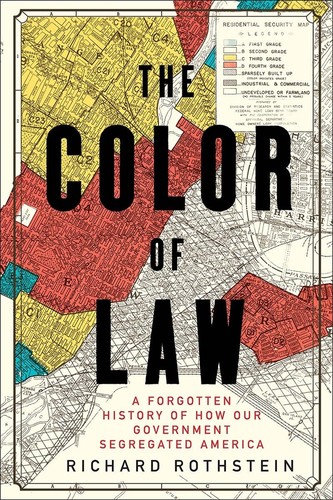
Talk to The Color of Law: A Forgotten History of How Our Government Segregated America like its author wrote you back.
Get the ideas that fit your life — not generic summaries.
- Chat with the book
- Audiobook-style main ideas
- Adapts to your life and goals
- Helps you take action
Key takeaways
- 1.
American residential segregation is not primarily a product of private prejudice but of explicit government policy enforced through federal programs, court decisions, and local zoning.
- 2.
The Federal Housing Administration's redlining policy — refusing to insure mortgages in racially mixed neighborhoods — helped create the white suburban middle class while systematically excluding Black families.
- 3.
The GI Bill created unprecedented middle-class wealth for returning veterans but was administered in ways that largely excluded Black veterans from the suburban homeownership it financed for white veterans.
- 4.
Racially restrictive covenants were enforced by courts until 1948 and effective long after through private practice — making the legal system an active enforcer of segregation, not a neutral bystander.
- 5.
The wealth gap between Black and white Americans today is a direct and measurable consequence of these policies, which prevented wealth accumulation through real estate during the period of greatest middle-class expansion.
- 6.
De jure segregation — government-imposed, legally enforced — is constitutionally different from de facto segregation. Rothstein argues that most American segregation is actually the former mischaracterized as the latter.
- 7.
Local zoning decisions, urban renewal projects, and public housing placement were coordinated tools of racial separation, not incidental effects of race-neutral planning.
- 8.
Remedies for government-imposed segregation require government action; acknowledging the de jure nature of segregation is a precondition for that.
Discussion questions
Use these on your own, with a book club, or as chat starters in Superbook. Book club version, ready to copy or print →
- 1.
Rothstein distinguishes de jure from de facto segregation. Before reading the book, which did you think better described American residential patterns?
- 2.
The FHA redlining maps explicitly rated neighborhoods by racial composition. Who in the federal government made those decisions, and what does their institutional context tell you?
- 3.
The GI Bill is often cited as a major driver of middle-class wealth creation. Does Rothstein's account of its racially discriminatory administration change how you think about postwar prosperity?
- 4.
Rothstein focuses on government policy rather than private prejudice. Does that framing feel complete to you, or does it leave something important out?
- 5.
The wealth gap argument depends on the claim that homeownership in appreciating suburbs was the primary vehicle of middle-class wealth accumulation. Is that premise well established?
- 6.
The Supreme Court's 1948 Shelley v. Kraemer decision ruled racially restrictive covenants unenforceable. Rothstein argues they remained effective anyway. What does that tell you about the relationship between legal rights and practical reality?
- 7.
If Rothstein's argument is correct that this is de jure segregation, what obligations does that create? What kinds of remediation would follow?
- 8.
The book covers policies from the 1930s through the 1970s. At what point, if any, do you think historical government actions stop creating current obligations?
- 9.
Rothstein writes with restraint about policies that are obviously unjust. Does that rhetorical choice make the book more or less effective?
- 10.
Public housing in the book begins as a New Deal program partly intended for white working-class families and becomes associated almost exclusively with Black poverty. What policies drove that transformation?
- 11.
The book focuses on the federal level but also covers state and local governments. Which level of government appears most directly responsible in Rothstein's account?
- 12.
How does reading The Color of Law change how you look at suburban neighborhoods, property values, or the geography of your own city?
Themes
Frequently asked questions
-
Is The Color of Law worth reading?
Yes. It is one of the clearest and most carefully documented arguments about the institutional origins of racial inequality in America. The writing is accessible and the evidence is specific. Readers who want to understand why American cities look the way they do will find it directly useful.
-
What is the main argument of The Color of Law?
That American residential segregation was imposed by government policy — federal, state, and local — and is therefore de jure rather than de facto. This matters because it establishes a legal obligation for remediation that the country has largely avoided acknowledging.
-
How long does it take to read The Color of Law?
Around five to six hours. At about 230 pages of main text it reads quickly, though the endnotes contain substantial additional evidence that rewards attention from readers who want the full documentation.
-
Who should read The Color of Law?
Anyone interested in American housing, race, or urban history. It is particularly useful for readers who want to understand the wealth gap between Black and white Americans in terms of specific historical mechanisms rather than cultural or individual explanations.
-
Does The Color of Law propose specific remedies?
Rothstein discusses potential remedies in the final chapter, including subsidized mobility programs, community land trusts, and reforms to exclusionary zoning, but the book's main work is diagnostic. He argues that remediation cannot be designed without first acknowledging what the government actually did.
Similar books
Caste: The Origins of Our Discontents
Isabel Wilkerson
The New Jim Crow: Mass Incarceration in the Age of Colorblindness
Michelle Alexander

Between the World and Me
Ta-Nehisi Coates
