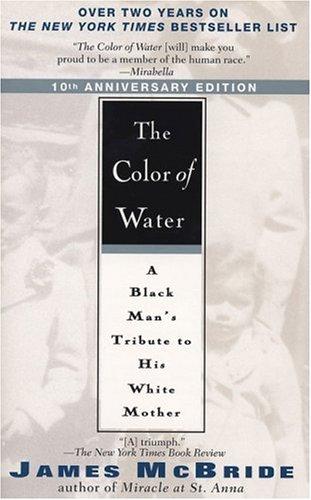
Talk to The Color of Water: A Black Man's Tribute to His White Mother like its author wrote you back.
Get the ideas that fit your life — not generic summaries.
- Chat with the book
- Audiobook-style main ideas
- Adapts to your life and goals
- Helps you take action
The Color of Water: A Black Man's Tribute to His White Mother, in detail
James McBride grew up in Brooklyn and Queens as one of twelve children raised by a white Jewish woman who had converted to Christianity and married a Black minister. His mother, Ruth McBride Jordan, refused to discuss her past. The Color of Water is McBride's account of his own coming-of-age and his mother's story — told in alternating chapters, his in first person, hers reconstructed from interviews — as he finally pieces together who she was.
Ruth McBride was born Ruchel Dwajra Zylska in Poland, brought to the United States as a child, raised in rural Virginia by a rabbi father who was by her account violent and financially exploitative, and later escaped to New York, where she became pregnant by a Black boyfriend, converted to Christianity, and eventually married twice into the Black community. She raised all twelve of her children to pursue education with a ferocity that brooked no argument. Eight of them earned graduate degrees.
The dual-voice structure is the book's most effective formal choice. McBride's chapters are self-critical, often funny — he describes getting into drugs and drifting in his teens before his mother, characteristically, refused to let him stay there. Ruth's chapters are more guarded; the interviews took years to extract from her. By the time the full picture assembles, the reader has experienced the same slow discovery McBride did.
The Color of Water is not primarily about race, though race structures every chapter. It is about what parents choose to pass down and what they choose to bury, and about what it costs children to carry mysteries they can't name. McBride eventually reconciles the person he found with the mother who raised him, and the reconciliation is earned rather than sentimental. The book's enduring readership speaks to its ability to hold the specific and the universal in the same frame.
The big ideas
- 1.
Children of parents who refuse to discuss their past inherit the emotional residue of those silences without the context to understand them.
- 2.
Ruth's insistence on education was not abstract — it was a strategy rooted in her own experience of vulnerability and her understanding that credentials provided protection her children's skin color would not.
- 3.
Identity is not singular. McBride grew up racially Black in a culturally complex household, raised by a Jewish-born Christian mother, shaped by two churches and multiple communities.
