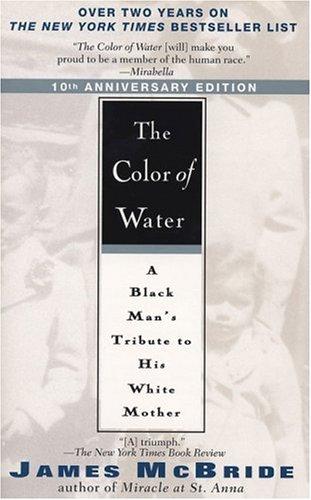
The Color of Water: A Black Man's Tribute to His White Mother by James McBride is a 1996 memoir book about family, race, identity. Children of parents who refuse to discuss their past inherit the emotional residue of those silences without the context to understand them.
Summary
James McBride grew up in Brooklyn and Queens as one of twelve children raised by a white Jewish woman who had converted to Christianity and married a Black minister. His mother, Ruth McBride Jordan, refused to discuss her past. The Color of Water is McBride's account of his own coming-of-age and his mother's story — told in alternating chapters, his in first person, hers reconstructed from interviews — as he finally pieces together who she was.
Ruth McBride was born Ruchel Dwajra Zylska in Poland, brought to the United States as a child, raised in rural Virginia by a rabbi father who was by her account violent and financially exploitative, and later escaped to New York, where she became pregnant by a Black boyfriend, converted to Christianity, and eventually married twice into the Black community. She raised all twelve of her children to pursue education with a ferocity that brooked no argument. Eight of them earned graduate degrees.
The dual-voice structure is the book's most effective formal choice. McBride's chapters are self-critical, often funny — he describes getting into drugs and drifting in his teens before his mother, characteristically, refused to let him stay there. Ruth's chapters are more guarded; the interviews took years to extract from her. By the time the full picture assembles, the reader has experienced the same slow discovery McBride did.
The Color of Water is not primarily about race, though race structures every chapter. It is about what parents choose to pass down and what they choose to bury, and about what it costs children to carry mysteries they can't name. McBride eventually reconciles the person he found with the mother who raised him, and the reconciliation is earned rather than sentimental. The book's enduring readership speaks to its ability to hold the specific and the universal in the same frame.
Talk to The Color of Water: A Black Man's Tribute to His White Mother like its author wrote you back.
Get the ideas that fit your life — not generic summaries.
- Chat with the book
- Audiobook-style main ideas
- Adapts to your life and goals
- Helps you take action
Key takeaways
- 1.
Children of parents who refuse to discuss their past inherit the emotional residue of those silences without the context to understand them.
- 2.
Ruth's insistence on education was not abstract — it was a strategy rooted in her own experience of vulnerability and her understanding that credentials provided protection her children's skin color would not.
- 3.
Identity is not singular. McBride grew up racially Black in a culturally complex household, raised by a Jewish-born Christian mother, shaped by two churches and multiple communities.
- 4.
The interleaved structure — McBride's present alongside Ruth's past — mirrors the way the past operates in families: always present, rarely explained.
- 5.
Ruth's survival required suppressing the history that would have made her too legible to the communities around her. The book frames that suppression as both cost and adaptation.
- 6.
McBride's teenage drift — drugs, aimlessness, confusion about his identity — is not treated as aberration but as a predictable response to growing up in a house full of questions no one answered.
- 7.
Forgiveness and understanding in the book are achieved through knowledge. McBride cannot fully accept his mother until he understands what she escaped.
- 8.
The book's title refers to Ruth's answer when asked about God's color: God is the color of water. The answer is the whole book — universal, refusing categorization, refusing the question.
Discussion questions
Use these on your own, with a book club, or as chat starters in Superbook. Book club version, ready to copy or print →
- 1.
Ruth spent decades refusing to discuss her past with her children. What do you think she believed she was protecting — her children or herself?
- 2.
McBride describes not knowing how to answer when people asked what he was — Black or white. How did growing up in an unclassifiable household shape his sense of self?
- 3.
Ruth's father is the most clearly damaging figure in her childhood. What does his failure reveal about the relationship between religious authority and domestic violence?
- 4.
The book alternates between McBride's voice and Ruth's. Which sections felt more alive to you, and what does that reveal about what each narrator can offer?
- 5.
Ruth's conversion from Judaism to Christianity is treated with ambivalence rather than triumph. What does the book suggest about religious conversion as a survival strategy?
- 6.
McBride got into trouble as a teenager while his siblings seemed to manage better. What factors in the book help explain that, and what does the book leave unexplained?
- 7.
Ruth raised twelve children with evident success by most conventional measures. What does the book acknowledge about the costs of her parenting style?
- 8.
The book was published in 1996. How has the conversation about race, interracial families, and identity changed since then, and does it affect how you read the story?
- 9.
Ruth's answer to questions about her race or background was often deflection or silence. Is that a form of wisdom or a form of evasion?
- 10.
McBride found his mother's history through interviews and research. How does the act of researching a parent change the relationship?
- 11.
What does the book suggest about what families owe each other in terms of honesty about their histories?
- 12.
The title is Ruth's answer about the color of God. Does that answer satisfy you? What do you think she means by it?
Themes
Frequently asked questions
-
Is The Color of Water worth reading?
Yes. It is one of the most enduring American memoirs of the past thirty years. The dual-voice structure works, the mother's story is genuinely surprising, and McBride's self-critical voice keeps the book from becoming hagiography. It's warm without being sentimental.
-
How long does it take to read The Color of Water?
Around five hours for the 291-page book. The alternating chapter structure creates natural stopping points, and the chapters are short enough to read in twenty-minute intervals.
-
What is The Color of Water about?
It's a memoir about James McBride discovering his white Jewish mother's hidden past while also recounting his own upbringing in a large, racially complex family in New York. It's as much his mother's story as his.
-
Who should read The Color of Water?
Readers interested in race, family, and identity in America. It is particularly relevant for anyone who has had a parent who refused to discuss their history, or who has navigated a mixed-race or mixed-culture identity. It is widely taught in American high schools and colleges.
-
What is the most memorable thing about the book?
Ruth's story. The discovery that this woman McBride's readers have been watching from the outside — formidable, evasive, relentlessly focused on her children's education — had a childhood and young adulthood of extraordinary difficulty is genuinely affecting. The interviews that produced her chapters must have required enormous trust on both sides.