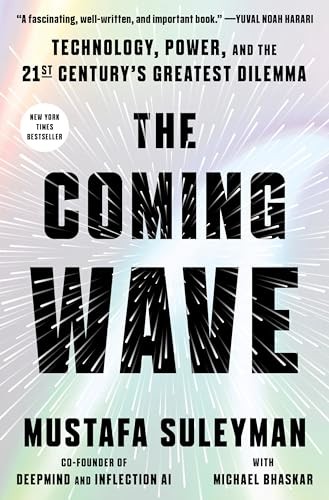
Talk to The Coming Wave like its author wrote you back.
Get the ideas that fit your life — not generic summaries.
- Chat with the book
- Audiobook-style main ideas
- Adapts to your life and goals
- Helps you take action
The Coming Wave, in detail
The Coming Wave is written by Mustafa Suleyman, co-founder of DeepMind and CEO of Microsoft AI, who is as inside the AI development world as anyone writing seriously about its risks. The book's central argument is that AI and synthetic biology together constitute a wave of technological change unlike any before it — not because they're unprecedented in scale, but because of a particular property Suleyman calls the "containment problem." Every prior general-purpose technology, from printing to nuclear weapons, has eventually been contained through law, norms, or physical constraints. AI and biotech, he argues, may be the first technologies that can't be.
The "containment problem" is the book's governing concept. Advanced AI is becoming cheaper, faster, and more accessible. The same is true of gene-editing tools. Both are omni-use technologies — they can be directed at almost any goal. When a technology is simultaneously powerful and cheap enough to diffuse across nation-states and non-state actors, the traditional instruments of containment — export controls, arms treaties, regulatory agencies — become structurally insufficient. Suleyman is not predicting catastrophe; he is arguing that the default trajectory is toward catastrophe unless specific, serious choices are made.
Suleyman is honest about the tension in his own position. He spent over a decade building the very technology he now describes as existentially risky. The book doesn't resolve this contradiction so much as sit inside it. He argues that the developers themselves are in the best position to build in safeguards, but that developer good intentions aren't enough without government action, international coordination, and technical mechanisms for controlling AI capabilities — what he calls "brakes" on the wave.
The proposals in the last third are deliberately concrete: audit requirements, liability regimes, international treaties modeled on nuclear non-proliferation, technical kill switches, staged deployment. Whether readers find them adequate or naive depends on their starting assumptions. What the book does undeniably well is make the geopolitical and technical logic of the problem legible to a non-specialist reader — and it does so with the credibility of someone who has been building frontier AI for fifteen years.
The big ideas
- 1.
AI and synthetic biology are 'general-purpose' technologies that can be directed toward almost any goal, making them structurally harder to contain than prior dangerous technologies like nuclear weapons.
- 2.
The containment problem: as these technologies become cheaper and more capable simultaneously, the instruments of control that worked for prior waves — treaties, export controls, regulation — become structurally insufficient.
- 3.
Synthetic biology poses risks comparable to AI: gene-editing tools are becoming accessible enough that the barrier to creating dangerous pathogens is dropping toward the capabilities of well-funded individuals or small groups.
