Talk to The Communist Manifesto like its author wrote you back.
Get the ideas that fit your life — not generic summaries.
- Chat with the book
- Audiobook-style main ideas
- Adapts to your life and goals
- Helps you take action
What it argues
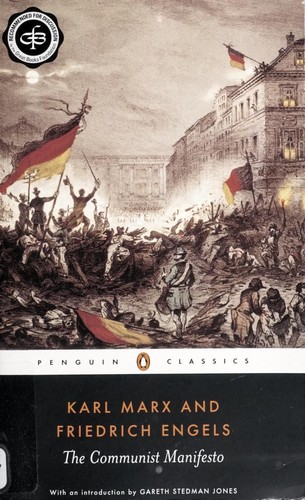
Published in 1848 on the eve of a wave of European revolutions, The Communist Manifesto is a short political pamphlet that has shaped more history than almost any other document of its length. Marx and Engels wrote it as a statement of purpose for the Communist League, but its audience quickly expanded beyond any single organization. Its opening claim — "The history of all hitherto existing society is the history of class struggles" — announced a framework for understanding politics, economics, and history that would influence movements worldwide for more than a century.
The argument is compact. Capitalism has created two opposed classes: the bourgeoisie, who own the means of production, and the proletariat, who sell their labor. The bourgeoisie, Marx and Engels argue, has been historically revolutionary — overthrowing feudalism and reshaping the world in its image — but it has also created the conditions for its own destruction. By concentrating workers in factories and cities, driving wages down, and reducing all social relations to market exchange, it manufactures the very class that will overthrow it.
What it gets right
- 1.
All history, Marx and Engels argue, is driven by conflicts between classes defined by their relationship to the means of production — not by ideas, great men, or national destiny.
- 2.
The bourgeoisie was historically revolutionary: it dismantled feudalism, built global markets, and transformed every corner of social life. But in doing so it created its own gravediggers.
- 3.
Capitalism tends to concentrate wealth, immiserate workers, and reduce all relationships — including family and politics — to market exchange. The Manifesto describes this as a feature, not a bug.
What it covers
Who wrote it
Karl Marx (1818–1883) was a German philosopher, economist, and political theorist whose work on capitalism, labor, and history remains among the most influential in modern thought. His major work, Capital, was published in three volumes between 1867 and 1894. Friedrich Engels (1820–1895) was Marx's lifelong collaborator, co-author, and financial supporter; he edited and published the later volumes of Capital after Marx's death. Together they developed the framework known as historical materialism. Both spent significant portions of their lives in political exile.
