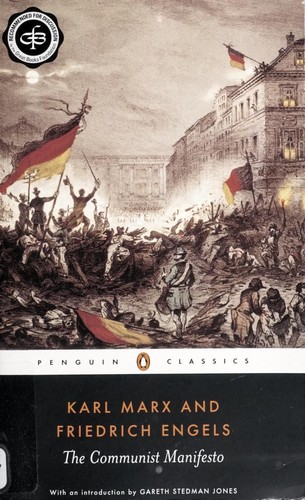
The Communist Manifesto by Karl Marx and Friedrich Engels is a 1848 history book about class struggle, political revolution, capitalism. All history, Marx and Engels argue, is driven by conflicts between classes defined by their relationship to the means of production — not by ideas, great men, or national destiny.
Summary
Published in 1848 on the eve of a wave of European revolutions, The Communist Manifesto is a short political pamphlet that has shaped more history than almost any other document of its length. Marx and Engels wrote it as a statement of purpose for the Communist League, but its audience quickly expanded beyond any single organization. Its opening claim — "The history of all hitherto existing society is the history of class struggles" — announced a framework for understanding politics, economics, and history that would influence movements worldwide for more than a century.
The argument is compact. Capitalism has created two opposed classes: the bourgeoisie, who own the means of production, and the proletariat, who sell their labor. The bourgeoisie, Marx and Engels argue, has been historically revolutionary — overthrowing feudalism and reshaping the world in its image — but it has also created the conditions for its own destruction. By concentrating workers in factories and cities, driving wages down, and reducing all social relations to market exchange, it manufactures the very class that will overthrow it.
The second section outlines what Communists want: abolition of private property in land and the means of production, a progressive income tax, centralization of credit in a national bank, free public education, and the abolition of child labor. The tone is blunt. The authors do not argue for gradual reform; they argue for the revolutionary transformation of society. The famous closing — "Workers of the world, unite! You have nothing to lose but your chains" — remains the most quoted rallying cry in radical politics.
Reading the Manifesto today requires holding two things in mind at once. As history, it predicted with some accuracy how industrial capitalism would develop and what social tensions it would generate. As a political program, the regimes that claimed it as their founding text mostly produced results Marx and Engels could not have anticipated. The text rewards careful reading precisely because its force comes not from a detailed blueprint but from a mode of analysis — asking who benefits from any given social arrangement, and at whose expense.
Talk to The Communist Manifesto like its author wrote you back.
Get the ideas that fit your life — not generic summaries.
- Chat with the book
- Audiobook-style main ideas
- Adapts to your life and goals
- Helps you take action
Key takeaways
- 1.
All history, Marx and Engels argue, is driven by conflicts between classes defined by their relationship to the means of production — not by ideas, great men, or national destiny.
- 2.
The bourgeoisie was historically revolutionary: it dismantled feudalism, built global markets, and transformed every corner of social life. But in doing so it created its own gravediggers.
- 3.
Capitalism tends to concentrate wealth, immiserate workers, and reduce all relationships — including family and politics — to market exchange. The Manifesto describes this as a feature, not a bug.
- 4.
The proletariat, concentrated in factories and cities, has the numbers, organization, and common interest to overthrow the capitalist order — if it develops class consciousness rather than competing with other workers.
- 5.
Private property in the means of production is the central institution the Manifesto targets, not personal ownership of household goods. The distinction matters for understanding what the authors actually proposed.
- 6.
Marx and Engels expected revolution first in the most industrialized countries. History largely went the opposite direction, which complicates how to read their predictions.
- 7.
The ten-point program in the second section is a practical minimum: progressive taxation, public education, abolition of inheritance, centralized banking. Much of it was eventually absorbed into liberal welfare states.
- 8.
The Manifesto is as much a rhetorical document as an analytical one. Its power comes from its certainty, its urgency, and its ability to name grievances workers already felt but hadn't articulated collectively.
Discussion questions
Use these on your own, with a book club, or as chat starters in Superbook. Book club version, ready to copy or print →
- 1.
Marx and Engels say all history is class struggle. What does that framework illuminate about a historical period you know well, and what does it miss?
- 2.
The Manifesto argues capitalism destroys everything solid and traditional. Is that still happening, and in what sectors of life do you see it most clearly today?
- 3.
How much of the ten-point program from 1848 has already been implemented in the country you live in? What does that suggest about how to read the text politically?
- 4.
Marx and Engels expected the most industrialized countries to revolutionize first. Why didn't that happen, and does it undermine the core argument?
- 5.
Is the distinction between owning the means of production and owning consumer goods still a meaningful one in a gig economy where individuals are encouraged to rent out their cars and apartments?
- 6.
The Manifesto treats nationalism as false consciousness — workers' real interests are international. How does that claim hold up when nationalism seems stronger than ever?
- 7.
Engels lived to see workers' parties form and win electoral seats. He updated his views accordingly. Does the text itself allow for that kind of revision, or does it close off certain possibilities?
- 8.
Where do you see the bourgeoisie vs. proletariat framing inadequate for understanding contemporary inequality — technology workers, gig workers, the professional class?
- 9.
The Manifesto is confident about historical direction. How do you think about its predictions given the actual history of Communist states in the twentieth century?
- 10.
What ideas in the Manifesto feel most alive today, and what feels most dated?
- 11.
Marx and Engels write that free trade benefits the bourgeoisie and immiserates workers. How does that claim look in light of global trade since 1990?
- 12.
If you were to write a manifesto about the class structures you see in contemporary society, what would it look like? Who are the classes and what are their interests?
Themes
Frequently asked questions
-
How long does it take to read The Communist Manifesto?
About an hour to ninety minutes. It is a pamphlet — around 40 pages in most editions. That brevity is deceptive; the ideas are dense and the historical context requires some background to fully appreciate. Many readers go through it twice.
-
What is The Communist Manifesto actually about?
It argues that all historical change is driven by class conflict, that capitalism has created an industrial working class with the power to overthrow it, and that communists should support revolutionary transformation rather than incremental reform. The second section outlines a practical minimum program for that transformation.
-
Is The Communist Manifesto worth reading today?
Yes, as a historical document and as intellectual history. Understanding how Marx and Engels framed capitalism and class is necessary context for a huge range of later political and social thought. Whether its prescriptions are sound is a separate question from whether the analysis is still worth engaging.
-
Who should read The Communist Manifesto?
Anyone interested in political theory, economic history, or the intellectual roots of left politics. It's also useful for anyone who wants to understand what Communist regimes were actually claiming to stand for, and where the gap between manifesto and reality opened up.
-
Is The Communist Manifesto anti-capitalism or something more specific?
It's specifically anti-capitalist in the sense of targeting private ownership of the means of production — factories, land, capital — rather than personal property. Marx and Engels also credited capitalism with genuine historical achievements before arguing it had to be superseded.