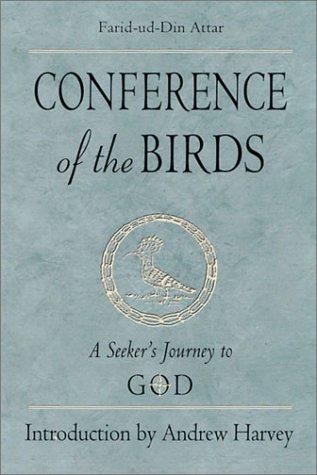
Talk to The Conference of the Birds like its author wrote you back.
Get the ideas that fit your life — not generic summaries.
- Chat with the book
- Audiobook-style main ideas
- Adapts to your life and goals
- Helps you take action
What it argues
The Conference of the Birds is a twelfth-century Persian allegorical poem by Farid ud-Din Attar in which a vast flock of birds assembles to seek their king, the mythical Simorgh. The hoopoe leads them, urging the birds to begin a journey across seven valleys — Quest, Love, Gnosis, Detachment, Unity, Bewilderment, and Poverty and Annihilation — each representing a stage of spiritual development in the Sufi tradition. The poem is framed as a debate: each type of bird offers an excuse for not making the journey, and the hoopoe answers each with a parable.
The structure is episodic. Between the main narrative, Attar embeds dozens of short stories — parables about kings, dervishes, lovers, and fools — that illuminate the valley through which the birds are passing. These embedded tales are often the most memorable part of the work. They are sharp, sometimes darkly comic, and almost always end with a turn that inverts what the reader expected. A king who seems cruel turns out to be merciful; a saint who seems enlightened is revealed as still attached to pride.
What it gets right
- 1.
The spiritual journey is structured as seven valleys — Quest, Love, Gnosis, Detachment, Unity, Bewilderment, and Annihilation — each demanding more complete surrender than the last.
- 2.
The poem's central paradox: the Simorgh the birds seek turns out to be themselves. The seeker and the sought are the same; the ego's sense of separateness is the only obstacle.
- 3.
Every excuse for not beginning the journey — fear, comfort, attachment to identity — is answered by a parable. Attar's method is story, not argument.
What it covers
Who wrote it
Farid ud-Din Attar was a twelfth-century Persian poet and Sufi mystic, born in Nishapur in what is now Iran. He is believed to have written over forty works, of which a handful survive with confidence. The Conference of the Birds, composed around 1177, is his most celebrated poem and one of the foundational texts of Persian Sufi literature. He was a pharmacist by trade and a deeply learned man; Rumi, who came after him, acknowledged Attar's formative influence on his own thought. The exact circumstances of Attar's death are disputed, though many sources associate it with the Mongol invasion of Nishapur in 1221.
