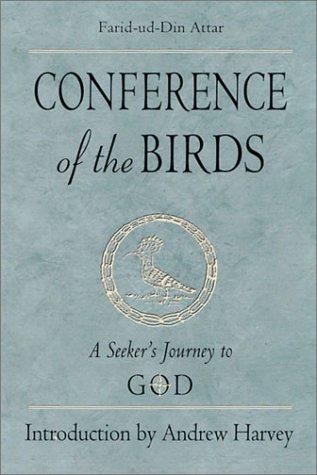
The Conference of the Birds by Farid ud-Din Attar is a 1984 philosophy book about spiritual quest, self-annihilation, mysticism. The spiritual journey is structured as seven valleys — Quest, Love, Gnosis, Detachment, Unity, Bewilderment, and Annihilation — each demanding more complete surrender than the last.
Summary
The Conference of the Birds is a twelfth-century Persian allegorical poem by Farid ud-Din Attar in which a vast flock of birds assembles to seek their king, the mythical Simorgh. The hoopoe leads them, urging the birds to begin a journey across seven valleys — Quest, Love, Gnosis, Detachment, Unity, Bewilderment, and Poverty and Annihilation — each representing a stage of spiritual development in the Sufi tradition. The poem is framed as a debate: each type of bird offers an excuse for not making the journey, and the hoopoe answers each with a parable.
The structure is episodic. Between the main narrative, Attar embeds dozens of short stories — parables about kings, dervishes, lovers, and fools — that illuminate the valley through which the birds are passing. These embedded tales are often the most memorable part of the work. They are sharp, sometimes darkly comic, and almost always end with a turn that inverts what the reader expected. A king who seems cruel turns out to be merciful; a saint who seems enlightened is revealed as still attached to pride.
The poem's central paradox arrives at the end. After surviving immense hardship, only thirty birds reach the Simorgh's court. There they discover that "Simorgh" in Persian means "thirty birds." The king they sought is what they have become — or rather, what they always were. The self they believed they needed to preserve was the only thing preventing the union they craved. Annihilation of the ego is not destruction but completion.
The English translation by Afkham Darbandi and Dick Davis, published by Penguin Classics in 1984, renders Attar's rhyming couplets in readable verse without sacrificing the poem's tonal range. Western readers who approach it as a philosophical text rather than purely a piece of world literature will find the seven-valley structure maps onto contemplative traditions far beyond Sufism — Buddhist concepts of ego-dissolution, Christian mystical theology of kenosis, and Vedantic non-dualism all share the same basic trajectory. That convergence is part of what has kept the poem in circulation for nearly nine centuries.
Talk to The Conference of the Birds like its author wrote you back.
Get the ideas that fit your life — not generic summaries.
- Chat with the book
- Audiobook-style main ideas
- Adapts to your life and goals
- Helps you take action
Key takeaways
- 1.
The spiritual journey is structured as seven valleys — Quest, Love, Gnosis, Detachment, Unity, Bewilderment, and Annihilation — each demanding more complete surrender than the last.
- 2.
The poem's central paradox: the Simorgh the birds seek turns out to be themselves. The seeker and the sought are the same; the ego's sense of separateness is the only obstacle.
- 3.
Every excuse for not beginning the journey — fear, comfort, attachment to identity — is answered by a parable. Attar's method is story, not argument.
- 4.
Self-annihilation (fana) is the goal, not destruction. To dissolve the self into the divine is not to be erased but to be made complete.
- 5.
The embedded parables function as teaching tools: they disorient, invert expectations, and show the reader truths they would resist if stated directly.
- 6.
The hoopoe's role as guide models the importance of a teacher who has already made the journey — Attar is writing under the influence of Sufi masters, particularly al-Ghazali.
- 7.
Only thirty of the thousands who set out arrive. Attar is honest that the path requires more than most are willing to give, and that the journey itself will strip away everything you think defines you.
- 8.
The poem is simultaneously theological, psychological, and political. The birds' excuses mirror human strategies for avoiding transformation at every scale.
Discussion questions
Use these on your own, with a book club, or as chat starters in Superbook. Book club version, ready to copy or print →
- 1.
The hoopoe counters every excuse for not journeying with a story rather than an argument. Why might Attar have chosen parable over direct instruction as his primary teaching method?
- 2.
Which bird's excuse for refusing the journey most resembles a resistance you recognize in yourself?
- 3.
The seven valleys end in annihilation and poverty. What would it mean, practically, to reach a state of zero attachment to your own identity?
- 4.
The Simorgh turns out to be the birds themselves. Does this resolution feel like a satisfying answer to the poem's question, or a deflection of it?
- 5.
Attar embeds stories-within-stories throughout the poem. How does this nested structure affect the way you receive the poem's teachings compared to reading a straightforward philosophical argument?
- 6.
The poem was written in the twelfth century but maps onto spiritual traditions across cultures. Which tradition, if any, does Attar's framework resemble most closely from your own background?
- 7.
Only thirty birds make it to the end. Attar presents this as realistic rather than tragic. Do you agree that the journey's difficulty is part of its meaning, or does that feel like spiritual elitism?
- 8.
The valley of Bewilderment comes just before the final one. Why might confusion and disorientation be a necessary stage rather than an obstacle to overcome?
- 9.
Many of the embedded parables feature rulers or saints who appear terrible but act out of hidden wisdom. What is the cost of that kind of teaching? Does it justify the harm along the way?
- 10.
The journey requires leaving behind attachments to family, comfort, reputation, and even religious practice. Which of those would be hardest for you to let go of?
- 11.
Attar wrote this poem while the Islamic world was under severe political pressure. How does knowing the historical context change how you read the poem's themes of endurance and annihilation?
- 12.
If you stripped the poem of its religious vocabulary, what is the core psychological claim it makes about human consciousness?
Themes
Frequently asked questions
-
What is The Conference of the Birds about?
It is an allegorical Sufi poem in which thousands of birds journey across seven spiritual valleys to find their king, the Simorgh. The journey is a metaphor for the soul's path toward union with the divine, ending in the dissolution of the ego.
-
Is The Conference of the Birds hard to read?
The Penguin Classics translation by Darbandi and Davis is accessible to general readers. The verse is clear, the parables are engaging, and the structure is well-explained. Some philosophical vocabulary takes adjustment, but no background in Sufism is required to follow the poem.
-
How long is The Conference of the Birds?
The Penguin edition runs about 230 pages including introduction and notes. At average reading pace, expect around three and a half to four hours.
-
Who should read The Conference of the Birds?
Anyone drawn to contemplative or mystical literature, comparative religion, or Persian poetry. It rewards readers interested in the psychology of spiritual transformation and holds up well alongside Western mystical texts like Meister Eckhart or John of the Cross.
-
What is the meaning of the ending?
The thirty surviving birds discover that 'Simorgh' means 'thirty birds' in Persian. The king they sought is what they have always been. Attar's point is that the divine is not a destination separate from the seeker — the journey's purpose was to strip away everything that obscured that unity.