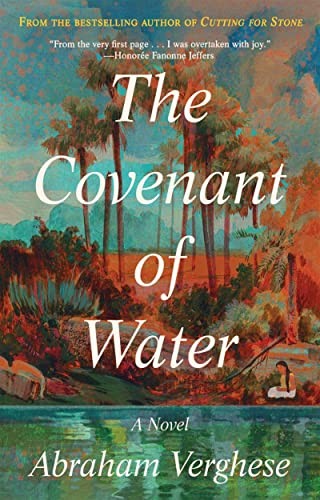
Talk to The Covenant of Water like its author wrote you back.
Get the ideas that fit your life — not generic summaries.
- Chat with the book
- Audiobook-style main ideas
- Adapts to your life and goals
- Helps you take action
What it argues
The Covenant of Water follows three generations of a South Indian Christian family from 1900 to 1977, centered on a community on the backwaters of Kerala. The novel opens with a twelve-year-old girl arriving as a bride in a household she has never seen, and it ends with her granddaughter becoming a surgeon in Scotland. In between, Verghese traces the family's recurring affliction — a condition that causes certain members to drown in shallow water — through a century of colonial rule, Indian independence, and the slow transformation of medicine from intuition to science.
What the book is about, more than plot, is the nature of a life in medicine as a form of love. Verghese is himself a physician and professor at Stanford, and The Covenant of Water is in many ways a meditation on what doctors were, are, and can be. The two major physician characters — a British surgeon who arrives in Kerala in the colonial era, and the granddaughter who becomes a surgeon after independence — are rendered with extraordinary specificity. Verghese knows what it feels like to put your hands on a patient and make a decision, and that knowledge gives the medical sections a weight that most fiction can't replicate.
What it gets right
- 1.
Medicine practiced with genuine care is depicted as one of the highest forms of human connection — not just technical skill but attentiveness to the full person.
- 2.
The recurring affliction that marks the family is never entirely explained, which is the point — some things about family and mortality resist diagnosis.
- 3.
Verghese's Kerala is rendered with such specificity that the setting becomes a character: its waterways, its Christian community, its complicated relationship with British colonialism.
What it covers
Who wrote it
Abraham Verghese is a physician, professor, and author based at Stanford University School of Medicine, where he is a senior associate chair. His memoir My Own Country explored the AIDS epidemic in rural Tennessee, and The Tennis Partner dealt with a friendship complicated by addiction. His nonfiction work has appeared in The New Yorker and The New York Times. The Covenant of Water is his second novel, following Cutting for Stone (2009), which sold over a million copies and spent more than two years on the New York Times bestseller list. He is known for his advocacy for the physical examination and the patient-physician relationship.
