Talk to The Dao of Capital like its author wrote you back.
Get the ideas that fit your life — not generic summaries.
- Chat with the book
- Audiobook-style main ideas
- Adapts to your life and goals
- Helps you take action
What it argues
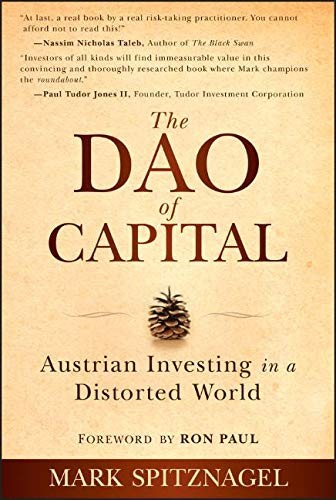
The Dao of Capital is Mark Spitznagel's argument for what he calls "roundabout" investing — the deliberate willingness to accept near-term losses or suboptimal returns in exchange for a position that will produce superior outcomes over a longer time horizon. Spitznagel, founder of the tail-risk hedge fund Universa Investments, draws on Austrian capital theory, Daoist philosophy, and historical military strategy to make his case. The result is an unusual book: intellectually ambitious, sometimes difficult, and unlike anything else in the investment literature.
The Austrian economics framework, particularly the work of Eugen von Böhm-Bawerk, is central to Spitznagel's argument. Böhm-Bawerk argued that "roundabout" production methods — those that take longer and require more upfront capital but increase output per unit of labor — are the engine of economic growth. Spitznagel applies this logic to investing: the investor who accepts near-term underperformance to position for future advantage will outperform the investor who optimizes each period independently. This is presented as a structural principle, not just a tactical preference.
What it gets right
- 1.
Roundabout methods — accepting near-term cost or underperformance to build a superior future position — are the structural advantage that separates durable wealth creation from short-term optimization.
- 2.
Austrian capital theory distinguishes between direct paths (immediately gratifying, often costly long-term) and indirect paths (temporarily costly, often superior long-term).
- 3.
Tail risk protection is not about making money from crashes. It is about preserving capital during crashes so it can be deployed aggressively when assets are cheap.
What it covers
Who wrote it
Mark Spitznagel is the founder and chief investment officer of Universa Investments, a tail-risk hedge fund he co-founded with Nassim Nicholas Taleb. He trained as a pit trader on the Chicago Board of Trade before founding Universa, which became widely known after its massive gains during the 2008 and 2020 market crashes. Spitznagel holds degrees from Kalamazoo College and New York University and studied Austrian economics under Murray Rothbard. The Dao of Capital, published in 2013, is his first book.
