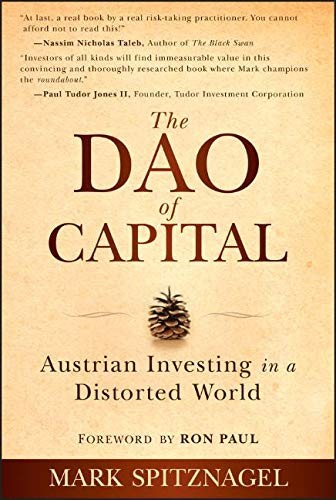
The Dao of Capital by Mark Spitznagel is a 2013 economics book about austrian economics, roundabout investing, tail risk. Roundabout methods — accepting near-term cost or underperformance to build a superior future position — are the structural advantage that separates durable wealth creation from short-term optimization.
Summary
The Dao of Capital is Mark Spitznagel's argument for what he calls "roundabout" investing — the deliberate willingness to accept near-term losses or suboptimal returns in exchange for a position that will produce superior outcomes over a longer time horizon. Spitznagel, founder of the tail-risk hedge fund Universa Investments, draws on Austrian capital theory, Daoist philosophy, and historical military strategy to make his case. The result is an unusual book: intellectually ambitious, sometimes difficult, and unlike anything else in the investment literature.
The Austrian economics framework, particularly the work of Eugen von Böhm-Bawerk, is central to Spitznagel's argument. Böhm-Bawerk argued that "roundabout" production methods — those that take longer and require more upfront capital but increase output per unit of labor — are the engine of economic growth. Spitznagel applies this logic to investing: the investor who accepts near-term underperformance to position for future advantage will outperform the investor who optimizes each period independently. This is presented as a structural principle, not just a tactical preference.
The practical investment implication is Spitznagel's approach to tail risk. He argues that most investors are perpetually exposed to catastrophic drawdowns and that they underestimate both the probability and the cost of those events. His firm's strategy involves accepting small, consistent losses on put options and similar instruments that pay off dramatically during market crashes. The goal is not to make money from these instruments directly but to preserve capital during crises so that it can be deployed aggressively when valuations collapse.
The Daoist thread running through the book — drawn from Sun Tzu and the concept of wu wei, or effortless action through strategic positioning — may feel like an unusual framework for finance. Spitznagel uses it to make a point about indirect paths to advantage: the most effective path is often not the one that appears most direct. This is consistent with the Austrian roundabout principle and with the psychological argument that investors systematically take the apparently direct path (maximizing current returns) at the expense of long-term outcomes.
The book is challenging. Spitznagel expects readers to engage with Austrian economic theory, and the historical sections on Böhm-Bawerk and the business cycle are dense. Readers who persist through the theoretical foundations will find the investment application section more approachable, but the book rewards patience rather than skimming.
Talk to The Dao of Capital like its author wrote you back.
Get the ideas that fit your life — not generic summaries.
- Chat with the book
- Audiobook-style main ideas
- Adapts to your life and goals
- Helps you take action
Key takeaways
- 1.
Roundabout methods — accepting near-term cost or underperformance to build a superior future position — are the structural advantage that separates durable wealth creation from short-term optimization.
- 2.
Austrian capital theory distinguishes between direct paths (immediately gratifying, often costly long-term) and indirect paths (temporarily costly, often superior long-term).
- 3.
Tail risk protection is not about making money from crashes. It is about preserving capital during crashes so it can be deployed aggressively when assets are cheap.
- 4.
Most investors underestimate the probability and impact of severe drawdowns and overestimate their ability to recover from them. This asymmetry drives the case for structural hedging.
- 5.
The business cycle, in the Austrian view, is driven by artificially low interest rates that encourage malinvestment — investments that would not be made at accurate prices.
- 6.
Daoist strategy and Austrian economics share a principle: the most powerful position is often achieved through apparent inaction or retreat rather than direct advance.
- 7.
Conventional portfolio optimization maximizes returns in each period independently. This produces portfolios that are catastrophically fragile to events outside the optimization window.
- 8.
Patient capital — money that can wait through periods of underperformance — is rarer and more valuable than the financial industry treats it. Most institutional mandates destroy patience.
Discussion questions
Use these on your own, with a book club, or as chat starters in Superbook. Book club version, ready to copy or print →
- 1.
Spitznagel argues that the willingness to underperform in the short term is the prerequisite for superior long-term outcomes. Can you think of examples in your own life where the roundabout path proved correct?
- 2.
How much of the Austrian economics framework did you find persuasive, and how much felt like theoretical scaffolding for a conclusion Spitznagel had already reached?
- 3.
Tail-risk hedging consistently loses small amounts of money in most market environments. How much would it take to convince you to hold an instrument that loses money most of the time?
- 4.
Spitznagel is deeply critical of central bank interest rate policy. Has the period since the book was published changed how you evaluate that critique?
- 5.
The book draws connections between Daoism, Austrian economics, and military strategy. Does that synthesis feel illuminating or forced?
- 6.
What does 'patient capital' look like in practice for an individual investor rather than a hedge fund? What institutional or psychological constraints make it difficult?
- 7.
Spitznagel argues most investors systematically underestimate tail risk. Do you agree? What evidence would you look for to test that claim?
- 8.
The roundabout principle suggests that accepting near-term disadvantage builds long-term advantage. Where in your professional or financial life have you failed to apply that principle?
- 9.
How does Spitznagel's approach compare to simply holding more cash or bonds as insurance against drawdowns? What's the difference in outcome and in logic?
- 10.
The book is dense and demanding. Did you find the difficulty proportionate to the value of the ideas, or does Spitznagel overcomplicate what could be stated more simply?
- 11.
Universa's tail-risk strategy performed dramatically well in 2020. Does one high-profile outcome validate the approach, or does it require a longer track record to assess?
- 12.
What would Spitznagel's roundabout principle applied to career strategy look like? Where might accepting a slower or less obvious path produce superior long-term outcomes?
Themes
Frequently asked questions
-
What is the main argument of The Dao of Capital?
That roundabout investing — accepting near-term underperformance to build a superior long-term position — is structurally superior to optimizing returns in each period. Spitznagel grounds this in Austrian capital theory and applies it specifically to tail-risk portfolio construction.
-
Is this book accessible to readers without an economics background?
Partially. The Austrian economics sections require patience and some prior exposure to capital theory. The investment application and philosophical sections are more accessible. Readers comfortable with Nassim Taleb's work will have the clearest entry point.
-
How does this book relate to Nassim Taleb's ideas?
Spitznagel and Taleb co-founded Universa and share a focus on tail risk and the fragility of conventional portfolio construction. The books complement each other, but Spitznagel's Austrian economics framework and the Daoist thread are his own and differ from Taleb's primarily philosophical and statistical approach.
-
Who should read The Dao of Capital?
Sophisticated investors, economics students, and readers curious about heterodox investment philosophy. Not suitable for readers looking for practical portfolio advice or for those new to investing. The book rewards prior familiarity with both economics and financial markets.
-
Has Spitznagel's approach been validated?
Universa's strategy generated exceptional returns during the 2008 and 2020 crashes while losing money in most intervening years. Whether this constitutes validation depends on your investment horizon and how you evaluate strategies that underperform consistently except in rare, extreme events.
Similar books
Antifragile: Things That Gain from Disorder
Nassim Nicholas Taleb
The Black Swan: The Impact of the Highly Improbable
Nassim Nicholas Taleb
The Intelligent Investor
Benjamin Graham
Principles for Navigating Big Debt Crises
Ray Dalio
