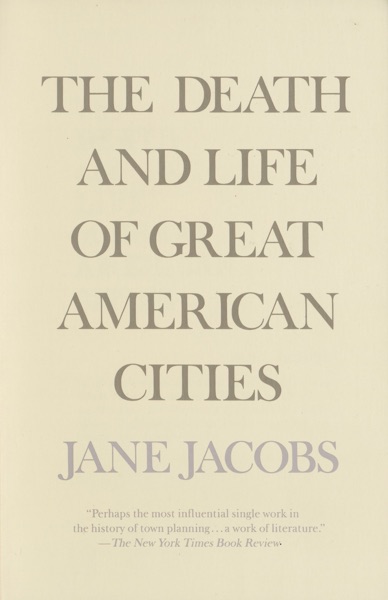
Talk to The Death and Life of Great American Cities like its author wrote you back.
Get the ideas that fit your life — not generic summaries.
- Chat with the book
- Audiobook-style main ideas
- Adapts to your life and goals
- Helps you take action
What it argues
The Death and Life of Great American Cities is Jane Jacobs's 1961 argument against the dominant urban planning orthodoxy of her era, and one of the most influential works of urban theory ever written. The midcentury planning establishment — led by figures like Robert Moses — believed cities could be improved by clearing "slums," separating uses into zones, building superblocks, and replacing dense street grids with towers in parks. Jacobs, a writer and editor who lived in Greenwich Village and watched her neighborhood nearly get demolished, argued that this approach was catastrophically wrong about how cities actually work.
Jacobs builds her case from the street up. The fundamental unit of a healthy city is the sidewalk, and the fundamental question is whether streets generate or drain life. She identifies four conditions that produce street vitality: a mix of primary uses (residential, commercial, civic) so that people are present at different times of day; short blocks that allow foot traffic to circulate freely; buildings of varying age that allow different economic activities (only old buildings can incubate low-margin uses); and sufficient density to support the full range of shops and services that make street life self-reinforcing.
What it gets right
- 1.
Cities are complex self-organizing systems. Attempts to plan them as if they were simple machines consistently produce the opposite of the intended effect.
- 2.
Street life requires a mix of uses so that people are present throughout the day. Single-use zoning — residential here, commercial there — produces dead zones at most hours.
- 3.
Short blocks matter. Long superblocks force foot traffic onto a few streets, draining the rest. The grid that allows circulation in any direction sustains a wider distribution of street life.
What it covers
Who wrote it
Jane Jacobs (1916–2006) was an American-Canadian writer and activist who had no formal training in urban planning or architecture. She worked as a journalist and editor in New York City and was a prominent opponent of Robert Moses's urban renewal and highway projects in lower Manhattan, including the successful campaign to block a highway through Washington Square Park. In 1968, she moved to Toronto, where she continued to write and organize around urban issues. The Death and Life of Great American Cities remains her most widely read work, though she wrote extensively on economic development, cities, and systems in books including The Economy of Cities and Cities and the Wealth of Nations.
