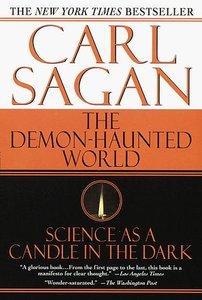
Talk to The Demon-Haunted World like its author wrote you back.
Get the ideas that fit your life — not generic summaries.
- Chat with the book
- Audiobook-style main ideas
- Adapts to your life and goals
- Helps you take action
What it argues
The Demon-Haunted World is Carl Sagan's argument that science is not just a body of knowledge but a way of thinking — one that humanity needs badly and uses far too rarely. Written in the mid-1990s as he was dying of myelodysplasia, it reads as a letter to a civilization he loved and worried about in equal measure. The central claim is that superstition, pseudoscience, and magical thinking are not harmless quirks but genuine dangers, and that the habits of mind that distinguish good science from bad reasoning are learnable, teachable, and urgently worth spreading.
Sagan moves between subjects that might seem unrelated — alien abductions, faith healing, witchcraft trials, crop circles, channeling, recovered memory, cold fusion — but the thread connecting them is constant. He is not mocking believers. He is asking what kinds of evidence would change our minds, and noticing that many popular beliefs are constructed in ways that make them unfalsifiable by design. His "baloney detection kit" is the book's most practical section: a checklist of logical fallacies, rhetorical tricks, and evaluative questions that anyone can apply to a claim before accepting or rejecting it.
What it gets right
- 1.
Science is a method for thinking, not just a collection of facts. Its power comes from demanding evidence, tolerating uncertainty, and building in mechanisms for correcting error.
- 2.
The 'baloney detection kit' — a set of tools for evaluating claims — includes checking for independent confirmation, considering alternative explanations, quantifying where possible, and watching for logical fallacies like ad hominem and argument from authority.
- 3.
Pseudoscience mimics the surface features of science — the jargon, the confident claims — while avoiding its core discipline: the willingness to be falsified. This is what distinguishes it from genuine inquiry.
What it covers
Who wrote it
Carl Sagan (1934–1996) was an American astronomer, planetary scientist, and author who spent most of his career at Cornell University. He contributed to NASA's early planetary missions and was a key figure in the search for extraterrestrial intelligence. His television series Cosmos: A Personal Voyage, broadcast in 1980, reached an estimated 500 million viewers and remains one of the most-watched science documentaries ever made. His other books include Cosmos, Contact, Pale Blue Dot, and Broca's Brain. Sagan won the Pulitzer Prize for The Dragons of Eden in 1978. He died of pneumonia in 1996 while completing this book with his wife Ann Druyan.
