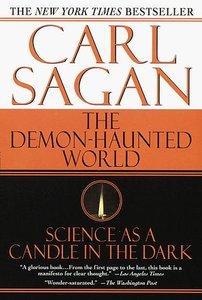
The Demon-Haunted World by Carl Sagan is a 1995 science book about skepticism, scientific thinking, critical thinking. Science is a method for thinking, not just a collection of facts. Its power comes from demanding evidence, tolerating uncertainty, and building in mechanisms for correcting error.
Summary
The Demon-Haunted World is Carl Sagan's argument that science is not just a body of knowledge but a way of thinking — one that humanity needs badly and uses far too rarely. Written in the mid-1990s as he was dying of myelodysplasia, it reads as a letter to a civilization he loved and worried about in equal measure. The central claim is that superstition, pseudoscience, and magical thinking are not harmless quirks but genuine dangers, and that the habits of mind that distinguish good science from bad reasoning are learnable, teachable, and urgently worth spreading.
Sagan moves between subjects that might seem unrelated — alien abductions, faith healing, witchcraft trials, crop circles, channeling, recovered memory, cold fusion — but the thread connecting them is constant. He is not mocking believers. He is asking what kinds of evidence would change our minds, and noticing that many popular beliefs are constructed in ways that make them unfalsifiable by design. His "baloney detection kit" is the book's most practical section: a checklist of logical fallacies, rhetorical tricks, and evaluative questions that anyone can apply to a claim before accepting or rejecting it.
The book is also, unexpectedly, a memoir of wonder. Sagan writes about his childhood hunger for science books, his admiration for the library as a democratic institution, and his conviction that the universe is actually stranger and more astonishing than any myth invented to explain it. He is not arguing that science kills mystery. He is arguing that the mystery science reveals is larger. The chapters on how science works — on independent replication, peer review, the willingness to be wrong — are written with the warmth of someone who genuinely loves the process, not just the results.
Where the book shows its age is in its specific targets: the Satanic panic, alien abduction reports, and New Age channelers of the early 1990s have faded. But the structure of the problem Sagan describes has not. He saw clearly that a society whose citizens cannot evaluate evidence is a society that cannot govern itself, and his final chapters on the relationship between science and democracy feel more urgent now than they likely did in 1995. The book is uneven in places — some chapters meander — but the core argument is one of the most important a scientist has made for a general audience in the twentieth century.
Talk to The Demon-Haunted World like its author wrote you back.
Get the ideas that fit your life — not generic summaries.
- Chat with the book
- Audiobook-style main ideas
- Adapts to your life and goals
- Helps you take action
Key takeaways
- 1.
Science is a method for thinking, not just a collection of facts. Its power comes from demanding evidence, tolerating uncertainty, and building in mechanisms for correcting error.
- 2.
The 'baloney detection kit' — a set of tools for evaluating claims — includes checking for independent confirmation, considering alternative explanations, quantifying where possible, and watching for logical fallacies like ad hominem and argument from authority.
- 3.
Pseudoscience mimics the surface features of science — the jargon, the confident claims — while avoiding its core discipline: the willingness to be falsified. This is what distinguishes it from genuine inquiry.
- 4.
Wonder and skepticism are not opposites. The universe as revealed by science is more astonishing than mythology, and treating it with rigor rather than credulity does not diminish it.
- 5.
A population that cannot evaluate evidence is easy to manipulate. Sagan saw authoritarian politics and scientific illiteracy as deeply linked problems, each feeding the other.
- 6.
Extraordinary claims require extraordinary evidence. The strength of a belief's holder, the sincerity of the believer, and the emotional resonance of a story are not evidence for the truth of a claim.
- 7.
Science is self-correcting by design. Wrong results eventually get found out; the process weeds errors in a way that no other system of knowledge-building reliably does.
- 8.
Maintaining an open mind is not the same as having no standards. Being open to any claim regardless of evidence is not intellectual humility — it is abdication.
Discussion questions
Use these on your own, with a book club, or as chat starters in Superbook. Book club version, ready to copy or print →
- 1.
Sagan distinguishes scientific skepticism from closed-mindedness. Where in your own thinking do you confuse the two?
- 2.
Pick a belief you hold that you have not seriously tried to falsify. What evidence would change your mind — and have you actually looked for it?
- 3.
The 'baloney detection kit' includes watching for appeals to authority. Which authorities do you trust without checking, and what would it take to update that trust?
- 4.
Sagan argues that pseudoscience fills a genuine human need. What needs — comfort, community, meaning — do you think it meets that science does not obviously provide?
- 5.
He worries that a scientifically illiterate public cannot maintain a democracy. Do you think that fear has proven well-founded in the decades since 1995?
- 6.
Alien abduction reports, recovered memories, and Satanic panic were the specific pseudosciences Sagan targeted. What are the equivalent belief systems generating similar damage today?
- 7.
Sagan is openly emotional about science — he describes his childhood wonder at libraries and the cosmos. Does that emotional register make his skeptical argument more or less persuasive to you?
- 8.
The book argues that the universe revealed by science is stranger and more awe-inspiring than myth. Do you find that compelling, or does it feel like a consolation prize?
- 9.
Where in your professional life do you accept claims without demanding the level of evidence Sagan would require? Is that a problem or a reasonable trade-off?
- 10.
Sagan was writing as he was terminally ill. Does knowing that context change how you read his urgency and his affection for human potential?
- 11.
He dedicates substantial space to the history of witch trials, treating them not as evidence of evil but as evidence of mass credulity under social pressure. What modern parallels come to mind?
- 12.
Sagan praises science's self-correcting nature. Can you think of an example where science corrected itself slowly and painfully rather than cleanly? What does that say about the argument?
Themes
Frequently asked questions
-
Is The Demon-Haunted World still worth reading today?
Yes. The specific pseudosciences Sagan targets have dated, but the reasoning tools he describes — how to evaluate claims, spot logical fallacies, and distinguish real evidence from compelling stories — apply directly to every information environment since, including the current one. The final chapters on science and democracy have aged particularly well.
-
How long does it take to read The Demon-Haunted World?
Around seven to eight hours at average reading pace for the 457-page book. The chapters vary in density; the early sections on alien abductions and the baloney detection kit move quickly, while the later chapters on democracy and scientific culture are slower and reward more careful attention.
-
What is the baloney detection kit?
Sagan's term for a practical checklist for evaluating claims. It includes questions like: Is there independent confirmation? Has the claimant looked for disconfirming evidence? Is the claim falsifiable at all? Are there simpler explanations? He also lists common logical fallacies — ad hominem, argument from authority, begging the question — as patterns to recognize and resist.
-
Who should read The Demon-Haunted World?
Anyone who wants a principled framework for thinking about contested claims, especially in a media environment designed to exploit credulous thinking. It is particularly useful for educators, journalists, and anyone whose work involves evaluating evidence. Readers already fluent in critical thinking will find less that is new, but the historical examples and Sagan's voice make it worth reading anyway.
-
What's the book's central argument in one sentence?
A civilization that cannot distinguish good evidence from bad reasoning is ungovernable and vulnerable — and the habits of mind that science embodies are the best defense humanity has developed against that vulnerability.