Talk to The Dhandho Investor like its author wrote you back.
Get the ideas that fit your life — not generic summaries.
- Chat with the book
- Audiobook-style main ideas
- Adapts to your life and goals
- Helps you take action
The Dhandho Investor, in detail
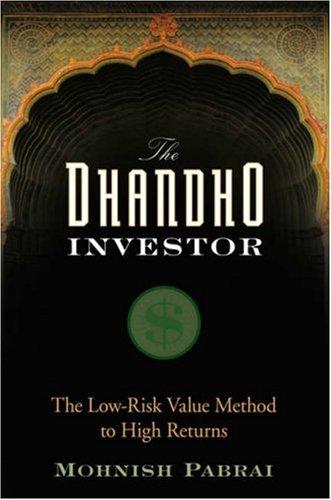
The Dhandho Investor is Mohnish Pabrai's application of value investing principles through the lens of "dhandho" — a Gujarati word roughly translating to business and wealth creation conducted with minimal risk. Pabrai opens with the story of Indian immigrant entrepreneurs, particularly the Patels who came to dominate the American budget motel industry in the 1970s and 1980s. Their approach to buying distressed businesses with little upfront capital, operating them conservatively, and expanding only when cash flow supported it became Pabrai's template for stock market investing.
The central framework is captured in the phrase "heads I win, tails I don't lose much." Dhandho investors seek situations where the downside is capped — by asset backing, by the nature of the business, by the price paid — while the upside is open. This asymmetry is the consistent theme: find cheap bets with limited downside and substantial upside potential. Pabrai draws on Charlie Munger's mental models and Buffett's letters as much as original thinking, acknowledging explicitly that his approach is an application of their ideas rather than an independent invention.
The book covers the nine principles Pabrai distills from the dhandho framework: invest in existing businesses, invest in simple businesses with durable competitive advantages, invest in distressed businesses in distressed industries, invest in businesses with a significant margin of safety, make few bets, make big bets, rarely make a new bet, focus on arbitrage opportunities, and maximize expected value. These are illustrated through case studies of Pabrai's own investments, including his position in a trailer manufacturer that he bought after the company's stock had fallen dramatically and which subsequently recovered substantially.
The limitation is that the book is explicitly derivative. Pabrai is upfront about this — he considers himself a student of Buffett and Munger rather than an originator. Readers who want the source material should read Buffett's letters and Poor Charlie's Almanack. What Pabrai adds is a systematized presentation of their ideas and the specific frame of asymmetric risk, which he articulates more directly than Buffett typically does.
The big ideas
- 1.
Dhandho investing seeks asymmetric bets: limited downside, substantial upside. The question before every investment is whether you are being paid adequately for the risk you are taking.
- 2.
The Patel motel story illustrates the power of starting with minimal capital, operating conservatively, and expanding only when cash flow supports it — a template applicable to investing as well as business.
- 3.
Invest in simple businesses you can understand. Complexity in a business model often hides problems and makes it harder to assess whether competitive advantage is durable.
