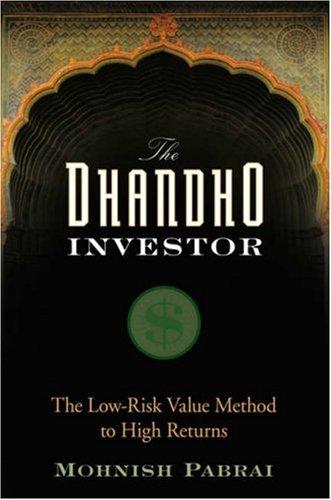
The Dhandho Investor by Mohnish Pabrai is a 2007 economics book about value investing, risk and uncertainty, capital allocation. Dhandho investing seeks asymmetric bets: limited downside, substantial upside. The question before every investment is whether you are being paid adequately for the risk you are taking.
Summary
The Dhandho Investor is Mohnish Pabrai's application of value investing principles through the lens of "dhandho" — a Gujarati word roughly translating to business and wealth creation conducted with minimal risk. Pabrai opens with the story of Indian immigrant entrepreneurs, particularly the Patels who came to dominate the American budget motel industry in the 1970s and 1980s. Their approach to buying distressed businesses with little upfront capital, operating them conservatively, and expanding only when cash flow supported it became Pabrai's template for stock market investing.
The central framework is captured in the phrase "heads I win, tails I don't lose much." Dhandho investors seek situations where the downside is capped — by asset backing, by the nature of the business, by the price paid — while the upside is open. This asymmetry is the consistent theme: find cheap bets with limited downside and substantial upside potential. Pabrai draws on Charlie Munger's mental models and Buffett's letters as much as original thinking, acknowledging explicitly that his approach is an application of their ideas rather than an independent invention.
The book covers the nine principles Pabrai distills from the dhandho framework: invest in existing businesses, invest in simple businesses with durable competitive advantages, invest in distressed businesses in distressed industries, invest in businesses with a significant margin of safety, make few bets, make big bets, rarely make a new bet, focus on arbitrage opportunities, and maximize expected value. These are illustrated through case studies of Pabrai's own investments, including his position in a trailer manufacturer that he bought after the company's stock had fallen dramatically and which subsequently recovered substantially.
The limitation is that the book is explicitly derivative. Pabrai is upfront about this — he considers himself a student of Buffett and Munger rather than an originator. Readers who want the source material should read Buffett's letters and Poor Charlie's Almanack. What Pabrai adds is a systematized presentation of their ideas and the specific frame of asymmetric risk, which he articulates more directly than Buffett typically does.
Talk to The Dhandho Investor like its author wrote you back.
Get the ideas that fit your life — not generic summaries.
- Chat with the book
- Audiobook-style main ideas
- Adapts to your life and goals
- Helps you take action
Key takeaways
- 1.
Dhandho investing seeks asymmetric bets: limited downside, substantial upside. The question before every investment is whether you are being paid adequately for the risk you are taking.
- 2.
The Patel motel story illustrates the power of starting with minimal capital, operating conservatively, and expanding only when cash flow supports it — a template applicable to investing as well as business.
- 3.
Invest in simple businesses you can understand. Complexity in a business model often hides problems and makes it harder to assess whether competitive advantage is durable.
- 4.
Concentrate bets. Pabrai argues that diversification is a hedge against ignorance; if you know what you're doing, a concentrated portfolio of your best ideas will outperform.
- 5.
Distressed businesses in distressed industries often offer the best margins of safety because selling pressure is indiscriminate — both genuinely broken and temporarily impaired businesses fall together.
- 6.
Cloning the investment approach of demonstrated investors — Buffett, Munger — is a legitimate and underrated strategy. Intellectual humility about your own originality is an advantage.
- 7.
Patience is structural. Great opportunities arrive infrequently, and the investor who can wait without forcing capital into mediocre situations has a persistent edge.
- 8.
The Kelly criterion provides a mathematical framework for sizing positions: bet larger when you have a large edge, smaller when the edge is narrow, never so large that a loss is unrecoverable.
Discussion questions
Use these on your own, with a book club, or as chat starters in Superbook. Book club version, ready to copy or print →
- 1.
Pabrai describes himself as a cloner of Buffett and Munger rather than an original thinker. Is that level of intellectual humility unusual in investing? Does it make his advice more or less credible?
- 2.
The Patel motel story is about operating a business, not buying stocks. What specifically transfers from that story to equity investing, and what does not?
- 3.
Pabrai advocates concentration — few, large bets in your highest-conviction ideas. What is the psychological cost of concentration when one of your few large positions declines 50%?
- 4.
The 'heads I win, tails I don't lose much' framework requires estimating both upside and downside. Where does that estimation most commonly go wrong?
- 5.
Pabrai's recommendation to copy great investors rather than develop original ideas is provocative. What would you lose if you simply ran a mechanical copy of Berkshire Hathaway's disclosed positions?
- 6.
The Kelly criterion tells you how much to bet given an edge and a payoff ratio. Have you ever sized a financial decision this formally? Would applying it change your behavior?
- 7.
Pabrai invests in distressed businesses in distressed industries. What is the specific risk in that approach — what goes wrong when the distress turns out to be permanent rather than temporary?
- 8.
The book covers Pabrai's successes in detail. How should you evaluate an investment framework when you can't see the full track record, including the failures?
- 9.
Dhandho principles work in private business. What barriers prevent most people from applying them to their actual small business decisions rather than to stock portfolios?
- 10.
Pabrai describes patience as a structural advantage. What conditions in your own financial and psychological situation would allow you to wait genuinely, rather than forcing decisions?
- 11.
Pabrai paid $650,100 to have lunch with Warren Buffett. What would you ask, and how would you evaluate whether it was worth the price?
- 12.
If you identified a distressed business in a distressed industry today, what three things would you check first to determine whether the distress was temporary or permanent?
Themes
Frequently asked questions
-
What does dhandho mean?
Dhandho is a Gujarati word roughly meaning business or the endeavor of creating wealth. Pabrai uses it to describe a style of investment characterized by minimal risk relative to potential return — investing structured so that if things go right you win significantly, and if things go wrong you lose little.
-
Is The Dhandho Investor worth reading if I've already read Buffett's letters?
It offers less than the letters do, since Pabrai explicitly acknowledges drawing from them. Its value is in the organized presentation of the framework, the Patel story as a concrete analogy, and the discussion of position sizing via Kelly. If you've read the letters carefully you'll recognize most of the ideas.
-
How long does The Dhandho Investor take to read?
Around three to four hours. It is clearly written, shorter than most value investing texts, and the case studies are concrete. A good single-sitting read.
-
What is Pabrai's actual investment track record?
Pabrai's funds significantly outperformed the market during their early years, then suffered severe losses in 2008-2009, followed by strong recoveries. His long-run performance is good but volatile. The concentrated approach he advocates produces both the outperformance and the occasional sharp drawdowns.
-
Who should read this book?
Investors drawn to value investing who want an accessible synthesis of Buffett and Munger's approach, framed around risk management and asymmetric bets. Best read alongside the Buffett letters and Charlie Munger's almanack for the source material Pabrai is distilling.