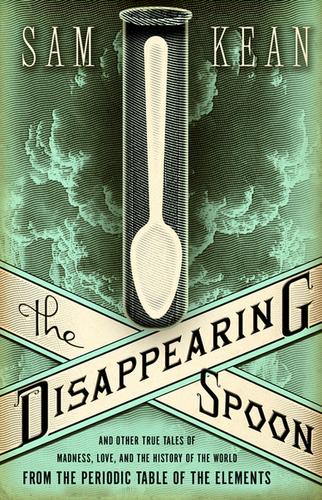
Talk to The Disappearing Spoon: And Other True Tales of Madness, Love, and the History of the World from the Periodic Table like its author wrote you back.
Get the ideas that fit your life — not generic summaries.
- Chat with the book
- Audiobook-style main ideas
- Adapts to your life and goals
- Helps you take action
What it argues
The Disappearing Spoon is Sam Kean's account of how the periodic table of elements came to be — not as a dry exercise in classroom science, but as a record of obsession, accident, rivalry, and the occasional poisoning. The title comes from gallium, a metal with a melting point low enough that a spoon made from it dissolves in a cup of hot tea. That kind of detail, the property that makes an element strange and memorable, is what Kean builds each chapter around.
Kean moves roughly along the table's rows and columns but rarely in a straight line. He covers the race to synthesize and name new elements, the political dimension of science during the Cold War and the Manhattan Project, and the peculiar lives of the chemists and physicists who discovered these materials. Marie Curie's notebooks are still too radioactive to handle without protective gear. Fritz Haber won the Nobel Prize for the nitrogen-fixation process that feeds half the world and is also responsible for poison gas in World War I. These stories don't simplify the science or the ethics. They carry both.
What it gets right
- 1.
Every element in the periodic table has a discovery story, and most of them involve competition, nationalism, and more than a little personal recklessness.
- 2.
Gallium melts in hot water; mercury drives people mad; polonium kills with a touch. Physical properties are not just chemistry — they're biography.
- 3.
Mendeleev arranged the table with gaps where undiscovered elements should be, then predicted their properties. The predictions were so accurate they effectively forced the elements into existence.
What it covers
Who wrote it
Sam Kean is an American science writer based in Washington, DC. He is the author of several books exploring the hidden histories of science and medicine, including The Violinist's Thumb, about the history encoded in DNA, and Caesar's Last Breath, about the science of gases. His work has appeared in Science, Mental Floss, The New Yorker, and Psychology Today. He is a regular contributor to public radio science programs and was named one of the best science writers in America by the American Institute of Physics. The Disappearing Spoon was a New York Times bestseller and his breakthrough book.
